
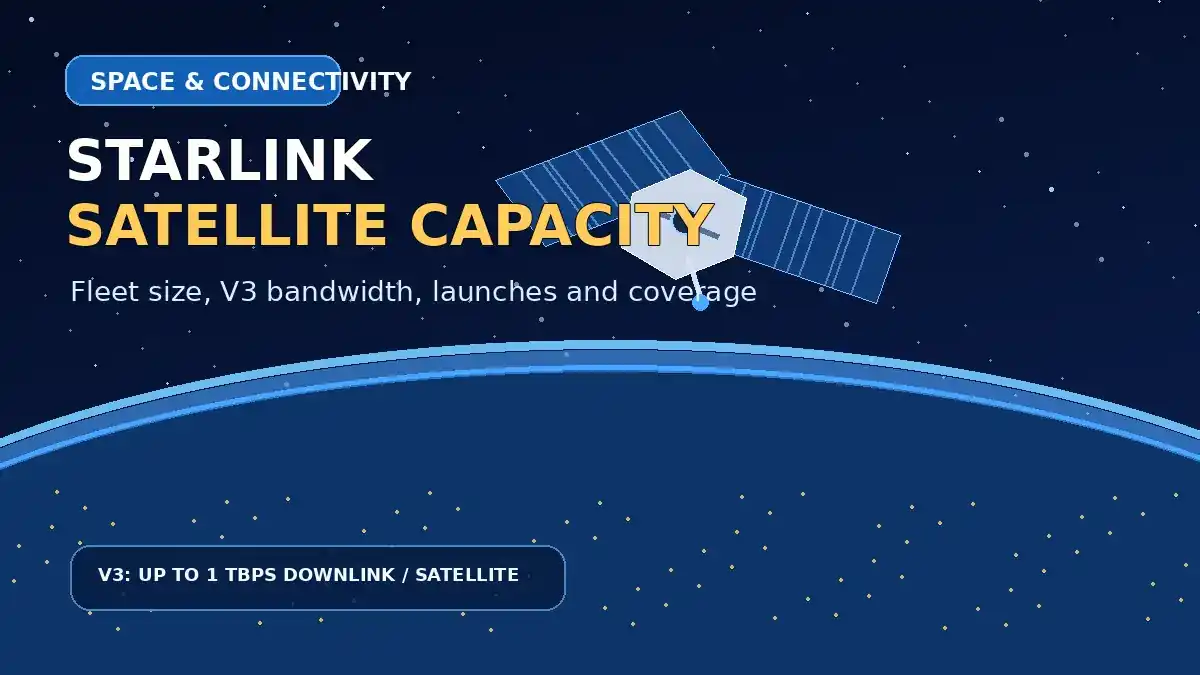
One Starlink satellite can now be designed to deliver more than a terabit per second of downlink capacity. That is a major change from the earlier generations of the network. But it does not mean a single home user will receive a one-terabit internet connection. Satellite capacity is shared across coverage areas, gateways, beams and customers. Understanding that difference is the key to understanding the real scale of Elon Musk’s Starlink network.
Starlink is also no longer a small experimental constellation. SpaceX said on October 6, 2026 that more than 11,000 Starlink satellites were in low Earth orbit. At the end of September, the company deployed the first 26 next-generation V3 satellites using Starship. The company has also described a much larger long-term plan, while regulators still control which satellites can actually be deployed and operated.
This guide explains Elon Musk Starlink satellite capacity in plain English. It covers how many Starlink satellites are in orbit, how many may be added in the future, the difference between V2 Mini and V3, how launches work, how often satellites are launched, how many fit on one rocket, satellite size, the famous Starlink satellite train and what the network is used for.
Starlink satellite capacity: the quick answer
| Question | Latest useful answer |
|---|---|
| How many Starlink satellites are in orbit? | SpaceX reported more than 11,000 in low Earth orbit on October 6, 2026. |
| How many V3 satellites were deployed first? | 26 V3 satellites were deployed on Starship Flight 14 on September 28, 2026. |
| V2 Mini downlink capacity | 96 Gbps per satellite, according to SpaceX’s 2026 prospectus. |
| V3 downlink capacity | 1,024 Gbps, or 1.024 Tbps, per satellite as designed by SpaceX. |
| How many V3 satellites could one Starship carry? | SpaceX says a future Starship launch could carry up to 60. |
| How many Starlink satellites are authorised under the FCC Gen2 decision? | The January 2026 FCC decision authorised an additional 7,500 Gen2 satellites, bringing the authorised Gen2 total to 15,000. |
| What is the company’s wider plan? | SpaceX said it plans to operate up to 100,000 Starlink satellites. That is a company plan, not a statement that 100,000 are already licensed or scheduled. |
Important: capacity per satellite, the number of satellites in orbit and the internet speed shown on a customer’s plan are three different measurements. They should not be used as if they mean the same thing.
What does Starlink satellite capacity actually mean?
When people search for Starlink satellite capacity, they may be asking about at least three different things. The first is the data capacity of one spacecraft: how much information it can transmit through its radio links. The second is the total capacity of the Starlink constellation: the combined network capacity available across thousands of satellites, ground stations and coverage cells. The third is the speed a customer can receive at home, on a boat or in a vehicle.
SpaceX’s published V2 Mini and V3 figures describe downlink capacity per satellite. Downlink is data travelling from the network towards users. It is not the same as the download speed on a residential plan. A satellite’s capacity is divided among multiple beams and users, and the amount available to one person depends on location, demand, spectrum, network routing and the service plan.
Think of a satellite as a very large highway interchange in the sky. A wider highway can move more traffic, but the number of cars that reach one home still depends on the roads, exits and traffic in that area. More capacity can reduce congestion and allow more customers to be served, but it does not give every customer the full capacity of the satellite.
Capacity also depends on the wider network. Starlink uses ground gateways where possible, laser links between satellites in space, user terminals on Earth and software that routes traffic. SpaceX said its constellation already incorporated more than 23,000 inter-satellite laser links as of March 31, 2026. Those links help route data through space rather than requiring every connection to travel through a nearby ground station.
How many Starlink satellites are in orbit in 2026?
The clearest current company figure is the one SpaceX published on October 6, 2026: it said more than 11,000 Starlink satellites were in low Earth orbit. That is the best headline figure to use for the question, “how many Starlink satellites are in orbit?” It is a rounded company statement, not a live count that updates every minute.
Counts can vary between satellite trackers because the word in orbit can include different categories. Some services count every catalogued Starlink object. Others separate satellites that are operational, manoeuvring, raising orbit, inactive or already lowering towards re-entry. A spacecraft can still be in orbit even when it is no longer providing internet service. A failed satellite may also remain in orbit for some time before atmospheric drag brings it down.
For context, SpaceX’s June 2026 prospectus said the company operated approximately 9,600 Starlink broadband and mobile satellites in low Earth orbit as of March 31, 2026. The October figure is higher because it is later in the year and includes months of additional launches. It is not a contradiction: the dates are different.
It is also useful to separate the broadband constellation from Starlink Mobile. SpaceX’s filing described approximately 650 dedicated mobile satellites as of March 31, 2026, alongside the wider broadband fleet. Some spacecraft support more than one service capability, so readers should avoid adding figures from different descriptions unless the company explains that they are separate groups.
How many Starlink satellites will be in orbit in the future?
There is no single guaranteed final number. The answer depends on how much of SpaceX’s proposed network is approved, how many satellites are manufactured, how quickly rockets can deploy them and how many older spacecraft are retired. The number in orbit will also change as satellites fail, deorbit or are replaced by newer models.
Two official figures are especially useful. First, on January 9, 2026, the Federal Communications Commission authorised SpaceX to deploy and operate an additional 7,500 second-generation Starlink satellites. The FCC said this brought the authorised Gen2 total to 15,000. Second, in its October 6, 2026 update, SpaceX said it plans to operate up to 100,000 Starlink satellites over the longer term.
Those numbers describe different things. The FCC’s 15,000 figure is a regulatory authorisation for the Gen2 system. The 100,000 figure is SpaceX’s wider stated plan. It should not be presented as a current FCC-approved operating total or as a guaranteed launch schedule. New filings, technical changes, orbital-safety rules and international spectrum coordination can all affect what is eventually deployed.
Why would SpaceX want so many satellites? The company wants to increase the amount of capacity available in busy regions, add coverage in areas where traditional networks are weak, support more mobile users and expand services for ships, aircraft and connected devices. More satellites can also improve how the network hands a connection from one spacecraft to another as satellites move quickly overhead.
V2 Mini vs V3: how much capacity can one satellite provide?
The most important change in the current capacity story is the move from V2 Mini to V3. SpaceX’s 2026 prospectus lists 96 Gbps of downlink capacity for V2 Mini and 1,024 Gbps for V3. That makes the designed V3 downlink capacity about 10.7 times the V2 Mini figure.
| Satellite generation | Published downlink capacity | What it means |
|---|---|---|
| V2 Mini | 96 Gbps | Second-generation model designed for Falcon 9 deployment. |
| V3 | 1,024 Gbps (1.024 Tbps) | Next-generation model designed for deployment by Starship. |
Capacity comparison chart
V2 Mini — 96 Gbps
V3 — 1,024 Gbps
Scale: the bars compare the published per-satellite downlink figures, not the speed delivered to one customer.
The chart shows why V3 matters. A satellite with around ten times the designed downlink capacity can contribute much more data capacity to the network. However, the real-world result depends on how many V3 satellites are in service, their orbital shells, how their beams are configured and how much demand exists in each area.
SpaceX says a single Starship flight could eventually carry up to 60 V3 satellites. The company has described that as a potential twenty-fold increase in downlink capacity deployed per launch compared with Falcon 9. That is a company comparison based on the different payloads and satellite generations; it is not a promise that every Starship mission will always carry 60 satellites.
How are Starlink satellites launched?
Starlink satellites are launched in groups, not one at a time. For many years, the main workhorse has been the reusable Falcon 9 rocket. A stack of flat satellites is loaded into the rocket’s payload fairing. Falcon 9 lifts off, the two stages separate, the upper stage takes the payload into the planned orbit and the satellites are released after the deployment sequence.
After release, the satellites do not instantly begin full commercial service. They check their systems, establish communication, deploy their solar arrays and use onboard electric propulsion to move towards their assigned orbital positions. SpaceX’s original launch material described this as a sequence of orbit raising, on-station service and end-of-life deorbit.
The first-stage booster usually returns to Earth and lands on a droneship or landing zone when the mission profile allows it. Reusing the booster helps reduce launch costs and allows SpaceX to fly more frequently than a system that throws away the entire rocket after every mission. The satellites themselves are not recovered for reuse after their service life; they are designed to leave orbit and burn up during re-entry.
V3 is different because the satellites are larger and heavier than the models designed for Falcon 9. SpaceX is using Starship to deploy them. On September 28, 2026, Starship Flight 14 reached orbit and deployed the first 26 V3 satellites. SpaceX’s stated long-term target is up to 60 V3 spacecraft on a Starship launch, once the rocket and operations are ready for that larger payload.
How many Starlink satellites are launched at once?
The answer depends on the satellite generation and the rocket. Falcon 9 missions in 2026 have carried batches such as 27 or 29 Starlink satellites. For example, SpaceX’s August 25, 2026 mission deployed 29 satellites. A September 20 mission carried 27. These examples show why there is no single fixed batch size for every launch.
The first V3 deployment was a group of 26 spacecraft on Starship Flight 14. SpaceX says future Starship launches could carry up to 60 V3 satellites. That higher number is a future payload capability target, not the number already deployed on the September 2026 mission.
Searches for “how many Starlink satellites are launched at once” often return older figures from the first-generation fleet. Those figures should not be applied to V2 Mini or V3. The satellite is larger, the mass is different, the rocket payload limit changes and the orbital destination can affect how many spacecraft fit on a mission.
How often are Starlink satellites launched?
Starlink launches do not follow a simple public schedule such as every Monday or every two weeks. SpaceX launches when a mission is ready and when weather, range availability, rocket inspections, orbital requirements and regulatory approvals allow it. During periods of high launch activity, Starlink missions can occur several times in a week. At other times, there may be a longer gap.
There are also different launch sites and orbital planes to serve. Falcon 9 Starlink missions have launched from Florida and California. Each mission is designed for a particular orbital destination, so the launch team must coordinate the rocket, spacecraft, ground systems and airspace or sea-range restrictions.
For readers who want to follow the next launch, the most reliable starting points are the official SpaceX launch page and the Starlink updates page. A mission date can move, so a calendar entry from an old article should not be treated as a current confirmed launch time.
Starlink satellite size: how large are the spacecraft?
There is no single Starlink satellite size because SpaceX has launched several generations. Early V1.5 spacecraft were much smaller than V2 Mini. The V2 Mini name can also be misleading: “Mini” means a smaller version of the planned full-size V2 satellite for Starship, not a small satellite in everyday terms.
Public dimensions based on SpaceX’s FCC filing show a V2 Mini satellite bus of about 4.1 metres by 2.7 metres. Its two solar-array wings extend after deployment. Spaceflight Now reported that the deployed arrays create a span of roughly 30 metres, or about 100 feet. The V2 Mini mass at launch is commonly reported at around 800 kilograms, although an optimised version can be lighter.
That is a very different object from the small Starlink Mini dish sold to customers. The user terminal is the flat antenna installed at a home or taken on a trip; the satellite is the spacecraft orbiting hundreds of kilometres above Earth. Search results sometimes mix up these two products, so check whether a page is discussing a satellite or a dish before using its dimensions.
SpaceX has not published a complete, final public dimension sheet for every V3 configuration. It is safe to say that V3 is a larger, higher-capacity spacecraft designed for Starship, but avoid repeating exact V3 measurements from unofficial diagrams as if they were confirmed company specifications.
What is the Starlink satellite train?
A Starlink satellite train is a group of newly launched satellites that appear as a neat line of bright dots moving across the night sky. The satellites have not formed a permanent line or joined together. They are simply close to one another after deployment and are travelling along a similar path while they begin moving into their assigned positions.
The train is easiest to see during twilight, shortly after sunset or before sunrise. The ground may be dark while sunlight still reaches the satellites, allowing their surfaces to reflect light towards an observer. They do not need bright headlights or visible engines to appear in the sky. The light is reflected sunlight.
As the satellites raise their orbits and spread out, the line becomes longer and less obvious. A satellite generally completes an orbit in around 90 minutes, so the same group can pass over a location more than once in a night if the viewing geometry is right. Modern darkening and orientation measures also make many operational satellites harder to see than early batches.
For a viewing opportunity, use a satellite-tracking service and enter your location. Check the direction, elevation and time shortly before the pass because a forecast can change. Do not mistake every moving point of light for Starlink: other satellites and aircraft can look similar at a glance.
What are Starlink satellites used for?
The main purpose is broadband internet. Starlink uses low Earth orbit satellites to connect a customer terminal to the wider internet. Traditional geostationary satellites orbit much farther away, which can create higher latency. Starlink’s lower orbit allows signals to travel a shorter distance, helping support video calls, online games, cloud applications and normal web browsing where terrestrial broadband is limited.
1. Rural and remote home internet
Starlink can serve households far from fibre networks, cable systems and reliable mobile coverage. Building a new fibre line to a remote farm, mountain community or isolated island can be expensive. A satellite terminal can provide an alternative, provided it has a suitable view of the sky, a power source and access to the service in that country.
2. Ships, aircraft and moving vehicles
Maritime and aviation customers need connectivity beyond the reach of ordinary mobile networks. Specialised Starlink services and terminals can provide internet on ships, aircraft and other mobile platforms. These are different from a standard residential setup, and performance depends on the equipment, service plan, regulatory permission and environment.
3. Emergency and disaster response
When floods, fires, storms or earthquakes damage ground communications, a satellite terminal can help restore a connection for emergency teams, hospitals, relief organisations and communities. It is not a complete replacement for resilient terrestrial networks, but it can provide a useful independent path when local infrastructure is disrupted.
4. Direct-to-cell and connected devices
Starlink Mobile aims to extend connectivity to compatible phones and other devices through satellite-to-mobile technology. The exact service depends on approved spectrum, partner mobile operators, device support and the rules in each country. It should not be described as ordinary mobile coverage everywhere. Direct-to-cell service is a developing part of the network, and some markets have different features or launch timelines.
5. Business, government and field operations
Construction teams, energy companies, agricultural operations, logistics providers and government agencies can use satellite connectivity at sites where reliable wired service is not available. For these customers, the value may be less about maximum download speed and more about dependable communications across a wide geographic area.
Why more satellites do not automatically mean faster internet for everyone
Adding satellites increases the network’s potential capacity and coverage, but the experience still depends on local conditions. A region with many customers may use a large share of the available capacity. A customer with trees, buildings or a poor view of the sky may have interruptions even when the constellation is large. Heavy rain can also affect some radio links, and local network design matters.
Starlink divides radio capacity among beams and users. The network can reuse frequencies in different areas and steer beams as satellites move, but it must manage interference and follow national spectrum rules. The number of satellites overhead is only one part of that calculation. Gateways, ground fibre, satellite-to-satellite links, terminal hardware and software all play a role.
That is why a 1.024 Tbps V3 satellite should not be interpreted as a promise that every Starlink customer will receive 1.024 Tbps. It is a per-satellite network capacity figure. Individual speeds are much lower and are shared across users in the relevant coverage area.
What could slow Starlink’s expansion?
Launching more satellites creates engineering and regulatory challenges. SpaceX has to build spacecraft at scale, manufacture terminals, secure spectrum rights, coordinate with other operators and manage the risk of collisions. Every satellite needs an orbital path that is compatible with other spacecraft and debris. The more objects placed in low Earth orbit, the more important accurate tracking and data sharing become.
A satellite also has a finite working life. It needs power, thermal control, propulsion, reliable software and components able to survive radiation and temperature changes. When a spacecraft reaches the end of its useful life, it should be moved out of its operational orbit and allowed to re-enter the atmosphere in a controlled way. This replacement cycle is one reason a constellation is not a one-time construction project.
There are wider public concerns as well. Astronomers have raised concerns about satellite trails in telescope images and radio interference. Space operators have to work on brightness mitigation, coordination and safe deorbit plans. More capacity can be valuable, but the quality of the system also depends on responsible orbital management.
What does Starlink’s capacity mean for SpaceX investors?
Starlink is a major connectivity business inside SpaceX, so the expansion of its satellite network matters to the company’s revenue potential, operating costs and long-term strategy. SpaceX shares began trading on Nasdaq in June 2026 under the ticker SPCX. That does not mean Starlink has a separate stock symbol: investors buying SPCX are buying shares in Space Exploration Technologies Corp., not a standalone Starlink company.
For investors, satellite capacity is only one part of the story. They also need to assess subscriber growth, average revenue per user, service availability, launch cost, terminal economics, competition, spectrum access, capital expenditure and the reliability of Starship. A satellite that can carry more data is useful only if the wider network can put that capacity to work at a cost that supports the business.
Readers following the wider space sector can also compare SpaceX’s approach with listed launch and satellite businesses such as Rocket Lab. For a separate example of how to distinguish a space project from a listed company, see our explainer on why Chandrayaan-3 does not have its own share price. These are different businesses and should not be treated as direct substitutes for Starlink.
How to track Starlink launches and satellites
Use official SpaceX launch announcements for launch dates and payload descriptions. The Starlink updates page is useful for company statements about network plans and new satellite generations. The FCC website is the place to check regulatory authorisations. Independent orbital trackers can help identify individual objects and see their current location, but their counts may differ because of cataloguing and status definitions.
When you compare two satellite-count pages, check the update date and ask what each number includes. Does it count all objects launched, all objects currently in orbit, only active satellites or only satellites at operational altitude? Without that context, two accurate databases can appear to disagree.
Frequently asked questions
How many Starlink satellites are in orbit right now?
SpaceX reported more than 11,000 Starlink satellites in low Earth orbit on October 6, 2026. Treat this as the latest rounded company figure in this guide, rather than a live second-by-second count. Independent trackers can show different totals depending on whether they include inactive spacecraft and satellites still raising or lowering their orbits.
How many Starlink satellites will be in orbit by 2030?
There is no confirmed 2030 total. The FCC authorised a Gen2 total of 15,000 satellites in its January 2026 decision, while SpaceX has stated a wider plan to operate up to 100,000 Starlink satellites. The larger figure depends on future regulatory approvals, manufacturing and launch capacity, and should not be treated as a guaranteed number for 2030.
How many Starlink satellites are launched at once on Falcon 9?
The number changes by mission. Recent examples include 29 satellites on an August 25, 2026 Falcon 9 mission and 27 on a September 20 mission. The payload depends on spacecraft generation, mass, orbit and rocket performance.
Can Starship launch more Starlink satellites than Falcon 9?
Yes, it is designed to. The first V3 deployment on Starship Flight 14 carried 26 satellites. SpaceX says a future Starship mission could carry up to 60 V3 satellites, with much more network capacity per launch than a Falcon 9 mission.
How big is a Starlink V2 Mini satellite?
Publicly reported specifications based on SpaceX’s FCC filing put the V2 Mini spacecraft bus at roughly 4.1 metres by 2.7 metres. Once its two solar-array wings are deployed, the total span is around 30 metres. Specifications can vary between V2 Mini versions, and these figures should not be applied to V3.
Why do Starlink satellites look like a moving train?
Newly deployed satellites start in a close group and then gradually move towards separate orbital positions. When sunlight reflects off the group while the ground is dark, the satellites can look like a line of bright dots. They spread out as they raise their orbits, so the train effect usually becomes less noticeable over time.
Are Starlink satellites visible every night?
No. Visibility depends on the satellite’s path, your location, the time of night, the season, cloud cover and the amount of reflected sunlight. Recently launched groups are often easier to see, while operational satellites are generally dimmer. Use a satellite pass prediction rather than assuming the satellites will appear at the same time every night.
Does 1 Tbps mean my Starlink internet speed will be 1 Tbps?
No. The 1,024 Gbps figure is the designed downlink capacity of one V3 satellite, not the speed promised to one customer. That capacity is shared across the network and many users. Your connection depends on the service plan, local demand, equipment, weather and network conditions.
Is Starlink a separate publicly traded stock?
No. Starlink is a business operated by SpaceX. SpaceX shares trade under the ticker SPCX, but there is no separate Starlink ticker. A person researching the business should distinguish the satellite internet service from the parent company’s publicly traded shares.
Final takeaway
Starlink’s scale is measured in more than the number of satellites above Earth. SpaceX reported more than 11,000 satellites in orbit in October 2026, and the first 26 V3 satellites were deployed in September. The V3 design is listed at 1,024 Gbps of downlink capacity per satellite, compared with 96 Gbps for V2 Mini. Those figures show why the next generation matters, but customer speed still depends on the shared network, local demand and ground infrastructure.
The most useful way to understand Elon Musk Starlink satellite capacity is to look at the whole system: satellites, rockets, orbital spacing, spectrum, laser links, user terminals and regulation. That is what turns a launch into a broadband service.
Sources and further reading
- Starlink / SpaceX update, October 6, 2026 — more than 11,000 satellites in orbit, first 26 V3 deployments and the stated long-term plan.
- SpaceX 2026 prospectus — V2 Mini and V3 capacity, constellation size as of March 31, 2026, and Starship deployment targets.
- Federal Communications Commission, January 9, 2026 — Gen2 Starlink authorisation.
- SpaceX Starship Flight 14 — September 28, 2026 V3 deployment.
- SpaceX Starlink mission, August 25, 2026 — example of a 29-satellite Falcon 9 batch.
- Spaceflight Now — V2 Mini dimensions and solar-array span.
- Space.com — how to see and understand a Starlink satellite train.
- SpaceX Investor Relations FAQ — company share and ticker information.