
Rate data checked: 31 October 2026 | Market: United States
The mortgage term you choose can change your monthly budget more than you expect. A 15-year loan usually clears the debt faster, while a 30-year loan spreads payments over a longer period. A shorter loan often has a lower rate, but a much larger required payment. Choosing between them is not just a math problem: it is also a choice about cash flow, savings and financial flexibility.
This guide compares 15-year vs 30-year mortgage rates today, explains monthly payments and total interest, and shows when each term may make sense. Bankrate’s daily averages on 28 October 2026 were 6.72% for a 15-year fixed purchase mortgage and 7.31% for a 30-year fixed purchase mortgage. Freddie Mac’s newer weekly averages for the week ending 29 October were 6.60% and 7.24%, respectively. These are different surveys, not personalised offers.
We also explain how a 20-year loan fits into the choice, how extra payments can affect a 30-year mortgage, and how to use the Easy Calculator Smart Mortgage Calculator to test your own loan amount and rate.
Key Takeaways
- Bankrate’s 28 October daily averages were 6.72% for 15 years and 7.31% for 30 years.
- Freddie Mac’s newer weekly averages, for the week ending 29 October, were 6.60% for 15 years and 7.24% for 30 years.
- A 15-year loan usually has a higher required monthly payment but lower total interest if held to term.
- A 30-year loan usually offers a lower required payment and more monthly flexibility.
- Compare loan estimates, APR, points, fees and how much you can safely pay each month.
For current rate context, read our mortgage rates today guide. For the longer trend, see our historical mortgage rates chart and mortgage rates meaning guide.
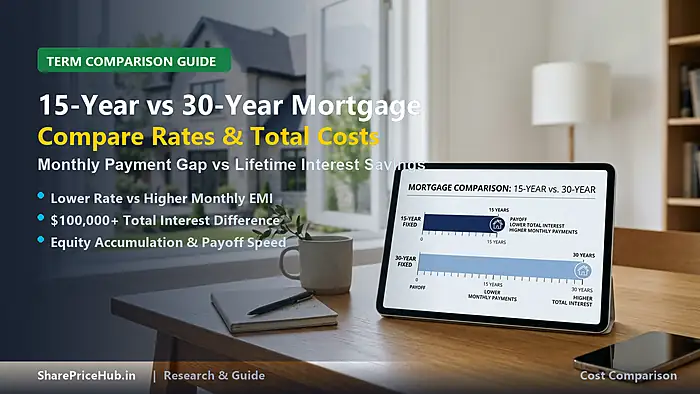
Quick Answer: 15-Year vs 30-Year Mortgage
A 15-year mortgage usually has higher monthly payments but lower total interest. A 30-year mortgage usually has a lower required payment but costs more interest if you keep it for the full term. The right option depends on whether you can comfortably afford the shorter loan without weakening emergency savings or other financial goals.
| Feature | 15-year fixed | 30-year fixed |
|---|---|---|
| Bankrate rate reference, 28 Oct 2026 | 6.72% | 7.31% |
| Typical required payment | Higher | Lower |
| Repayment period | 15 years | 30 years |
| Interest if held to full term | Usually lower | Usually higher |
| Monthly flexibility | Less | More |
| Main question | Can I safely afford the higher payment? | Will I use the lower payment responsibly? |
Source: Bankrate mortgage-rate averages. Rates are snapshots from 6:30 a.m. ET on 28 October 2026 and may change.
Contents
- How the terms work
- Payment comparison and chart
- Why total interest differs
- Extra payments on a 30-year loan
- Which term may fit your budget?
- APR, points and fees
- Use the mortgage calculator
- Frequently asked questions
1. How 15-Year and 30-Year Fixed Mortgages Work
A fixed-rate mortgage usually keeps its interest rate unchanged for the loan term. The scheduled principal-and-interest payment is calculated using the original balance, interest rate and number of monthly payments. Property taxes, homeowners insurance and mortgage insurance can still change, so a fixed mortgage does not mean every housing cost stays the same.
What happens with a 15-year term?
With a 15-year loan, the balance is scheduled to be repaid in 180 monthly payments. Because repayment happens more quickly, each payment includes more principal than a comparable 30-year loan. The balance falls faster, and interest has fewer years to build up.
The challenge is the size of the required payment. If income falls, expenses rise or the house needs an expensive repair, there is less room in the monthly budget. A borrower may qualify for a 15-year loan and still decide that a longer term is safer for the household.
What happens with a 30-year term?
A 30-year loan spreads payments across 360 months. The scheduled principal-and-interest payment on the same amount borrowed is lower, which may make it easier to manage other costs. The trade-off is slower principal repayment and a longer period in which interest can be charged.
The lower payment can help a homeowner maintain emergency savings, contribute to retirement, cover childcare or manage variable income. But that benefit depends on what the household does with the difference. If the lower payment simply leads to more spending and no savings, the financial flexibility may not deliver much long-term value.
Where does a 20-year mortgage fit?
A 20-year fixed mortgage sits between the common 15- and 30-year options. It may reduce total interest compared with a 30-year loan while requiring less each month than a 15-year loan. Lender availability and pricing vary. Get an actual quote rather than assuming the middle term is automatically the best compromise.
2. Monthly Payment Comparison: Same Loan, Different Terms
Consider a $300,000 loan. To isolate the effect of the repayment period, the next table uses the same illustrative 6.75% rate for both terms. It shows principal and interest only. It excludes property taxes, homeowners insurance, mortgage insurance, HOA fees, points and closing costs.
| Term at 6.75% | Approx. monthly payment | Total scheduled payments | Approx. total interest |
|---|---|---|---|
| 15-year fixed | $2,655 | About $477,851 | About $177,851 |
| 30-year fixed | $1,946 | About $700,486 | About $400,486 |
In this example, the 15-year payment is roughly $709 higher each month. In return, the loan is scheduled to finish in half the time and total interest is much lower if both loans run to completion. These are rounded calculations, not quotes from a lender.
The same-rate comparison is useful for understanding term length. Actual 15-year and 30-year offers often come with different rates, so ask lenders for both options. A shorter loan can have a lower rate, but credit profile, down payment, property type and lender pricing all affect the quote.
Simple payment chart
| Loan option | Monthly payment | Visual scale |
|---|---|---|
| 15-year at 6.75% | $2,655 | █████████████ |
| 30-year at 6.75% | $1,946 | ██████████ |
The bar lengths are only a simple illustration. A published graphic should label the loan amount, interest rate, term and excluded costs so that readers can reproduce the comparison.
3. Today’s 15-Year vs 30-Year Mortgage Rate Snapshot
Bankrate’s national average on 28 October 2026 showed 6.72% for a 15-year fixed purchase mortgage and 7.31% for a 30-year fixed purchase mortgage. Freddie Mac’s weekly survey for the week ending 29 October showed 6.60% and 7.24%, respectively.
These are not contradictory numbers. The two sources use different sampling and reporting methods. A daily national average, a weekly survey and a lender’s advertised “best rate” can all show slightly different figures. Write the source and date next to any rate used in an article.
References: Bankrate daily rate averages and Freddie Mac weekly survey archive and Freddie Mac’s 29 October 2026 release.
4. Why Total Interest Is Usually Lower on a 15-Year Loan
Interest is charged on the balance that remains unpaid. Early in a mortgage, the balance is large, so more of each payment goes toward interest. As principal is paid down, the interest portion becomes smaller and more of the payment reduces the balance.
A 15-year loan reduces principal faster and ends sooner. That means interest is charged over fewer months. A 30-year loan can cost substantially more in total interest even if its rate is only a little higher.
Yet the lowest total interest is not the only goal a household may have. Cash kept for emergencies, paying down credit-card debt, retirement saving or essential repairs can be valuable. A household should not put every available dollar into a larger mortgage payment and leave itself without a cash buffer.
5. Could a 30-Year Loan Plus Extra Payments Be Better?
Some borrowers choose a 30-year mortgage for its lower required payment and then make extra principal payments when the budget permits. This can reduce the balance faster and may shorten the payoff period. It gives the borrower a lower scheduled payment to fall back on during a difficult month.
The risk is that voluntary extra payments may not happen consistently. If the household spends the difference instead, the loan may run close to the full 30 years and cost more interest than expected. The plan works only when the borrower can follow it while keeping enough savings.
Check the servicing rules
Read the loan documents to understand whether extra principal payments are allowed and whether a prepayment penalty applies. When making an extra payment, confirm that the servicer applies it to principal rather than simply moving the next due date forward. Keep the confirmation for your records.
Compare both strategies side by side
Ask the lender for a 15-year quote and a 30-year quote. Then calculate the 30-year payment plus a realistic extra principal amount. Compare total interest, required payment, expected payoff date, fees and remaining cash. This helps show whether you are paying for flexibility you will actually use.
6. Which Mortgage Term May Fit Your Household?
A 15-year loan may suit a borrower who
- Has stable income and can comfortably afford the larger payment.
- Will still have emergency savings after the down payment and closing costs.
- Wants to reduce debt on a faster schedule.
- Values the certainty of an earlier payoff and has a budget that can support it.
A 30-year loan may suit a borrower who
- Needs a lower scheduled payment to keep the full household budget balanced.
- Has variable income or expects costs to rise.
- Wants to preserve cash for retirement, repairs or higher-rate debt.
- Plans to make extra payments only when finances allow rather than lock into a large obligation.
These are prompts for thinking, not personalised financial advice. A household with expensive debt may need to address that first. A person with irregular income may value flexibility more than rapid payoff. A household with substantial savings may prefer a shorter term. The answer depends on the full picture.
7. Compare APR, Points and Upfront Fees
The interest rate measures the price charged for borrowing principal. APR also includes certain loan costs expressed as an annual rate. APR can help compare offers, but it does not include every possible expense and depends in part on how long you keep the loan.
Discount points are upfront fees paid to lower the rate. Lender credits can reduce closing costs but may come with a higher rate. If you plan to move or refinance in a few years, paying more upfront for a lower rate may not be worthwhile. Ask the lender to show a break-even period using your expected time in the home.
Compare the Loan Estimate for each option. Check the interest rate, APR, points, lender charges, third-party costs, cash due at closing and any rate-lock conditions. A headline rate by itself does not show the whole borrowing cost.
8. Use a Mortgage Calculator Before You Decide
A calculator allows you to test different loan amounts, terms and interest rates before making an application. Compare the scheduled monthly payment and total interest, then add property taxes, homeowners insurance, mortgage insurance and HOA charges to create a more complete housing budget.
Use the Mortgage Calculator at EasyCalculatorSmart.com to compare 15-year and 30-year scenarios. Test a slightly higher rate as well as the rate you hope to receive. The result is an estimate, not a loan approval or an official lender offer.
9. Common Mistakes to Avoid
- Choosing by rate alone: payment, points, APR and total cost also matter.
- Ignoring emergency savings: a fast payoff plan can become stressful if cash is tight.
- Comparing different offers: loan amount, property, borrower profile and lock period should be comparable.
- Forgetting taxes and insurance: principal and interest are only part of housing costs.
- Assuming you will always make extra payments: build a plan around realistic cash flow.
- Ignoring time in the home: high upfront costs can take years to recover.
10. A Worked Borrower Example
Imagine two households purchasing homes for similar prices. The first has stable income, healthy emergency savings and a clear goal of reducing debt before retirement. The required payment on a 15-year loan may fit its budget. The second household has variable income and expects childcare costs to rise. A 30-year loan may give the second household a safer required payment, even if it plans to make extra principal payments in stronger months.
Neither example proves that one mortgage term is better for everyone. It illustrates why cash flow matters alongside total interest. A household that stretches to afford a 15-year loan may later need high-cost credit for an emergency. That can erase some of the benefit of paying the mortgage faster. A household choosing 30 years should still consider the long-term interest cost and plan how to use the lower required payment.
11. Checklist Before Choosing
- Request written quotes for both 15-year and 30-year options.
- Compare interest rate, APR, points, fees, cash needed at closing and rate-lock period.
- Estimate the full housing cost, including taxes, insurance, maintenance and HOA fees.
- Keep emergency savings after closing.
- Check how extra principal payments are handled and whether prepayment restrictions apply.
- Test higher-rate and lower-rate scenarios with a calculator.
A good mortgage is one you can keep paying in normal months and difficult months. Choose a structure that supports your goals without depending on a perfect forecast or a future refinance.
12. Think About the Cost of Flexibility, Too
The 30-year loan charges a kind of price for flexibility: the borrower has more years to pay back the debt, and interest can accrue for longer. Some households are comfortable with that trade because they prefer to keep their monthly obligation low. Others would rather pay more each month to end the debt sooner. Neither choice is automatically careless or smart; what matters is understanding the trade-off before signing.
When rates are high, buyers may focus mainly on getting the rate down. But term length, fees and a sustainable payment are just as important. A lender might offer a low rate with points, while another offers a higher rate with fewer upfront expenses. If you could move within several years, the second option may have a lower total cost despite the higher headline rate. Compare the expected cost over your likely time in the home, not only over 30 years.
Also check whether a mortgage includes features that affect flexibility, such as the ability to make lump-sum principal payments, skip or change payment dates under allowed conditions, or refinance without a large penalty. U.S. loan products differ, so never assume a feature is included unless the contract says so. Keep a copy of the Loan Estimate and closing documents and ask questions before closing if anything is unclear.
13. Why the Right Term Can Change During Your Life
A mortgage that fits at age 30 may not be the best fit at age 55. A household may start with a 30-year loan because it needs a lower payment, then increase principal payments as income rises. Another household may prefer a shorter term from the start because debt reduction is a top goal. Both approaches can be reasonable when they reflect an honest budget and not an assumption that income will always rise.
Consider future changes before choosing. Could one income stop for a period? Are you likely to pay for childcare, help family members, or replace a car? Do you expect to move within a few years? A mortgage is a long commitment, and a payment that leaves no room for change may increase financial pressure. The smaller required payment of a 30-year loan may be useful even if you plan to pay extra principal later.
14. A Practical Final Check
Before choosing, calculate the required payment for each term, add estimated taxes and insurance, review closing costs, and keep enough savings for unexpected expenses. Ask the lender whether the quoted rate is locked, how long it stays available, and whether points or other charges are included. Then compare the total expected cost over the period you think you will keep the loan.
The lowest-rate offer is not necessarily the best overall deal. The safest choice is the one whose costs you understand and whose required payment remains manageable without relying on future rate cuts, a guaranteed bonus or a refinance that may not be available later.
15. Frequently Asked Questions
What are 15-year vs 30-year mortgage rates today?
Bankrate showed national averages of 6.72% for 15-year fixed and 7.31% for 30-year fixed purchase mortgages on 28 October 2026. Freddie Mac’s weekly survey was 6.60% and 7.24% for the week ending 29 October. Personal offers vary.
Is a 15-year mortgage always cheaper?
It usually costs less interest if held to the end because principal is repaid faster. However, the required monthly payment is much higher. Upfront fees and actual lender pricing also matter.
How much more is the 15-year payment?
For a $300,000 loan at an illustrative 6.75%, estimated principal-and-interest payments are about $2,655 for 15 years and $1,946 for 30 years. This is a calculation example, not a quote.
Can I take a 30-year mortgage and pay it off in 15 years?
Some borrowers use extra principal payments to shorten the payoff period, subject to the loan terms. Confirm how the servicer applies extra payments and whether any prepayment terms apply.
Is a 20-year mortgage a good middle option?
It can be, if available at a competitive rate and the payment fits the budget. Compare the full Loan Estimate with both the 15-year and 30-year options.
Should I pay down a mortgage or invest the difference?
This depends on the mortgage rate, taxes, investment risk, liquidity, time horizon and other debt. Mortgage payments reduce debt, while investment returns can rise or fall. Consider qualified financial advice for your situation.
Where can I compare the payment?
Use the Easy Calculator Smart Mortgage Calculator to compare rates and terms.
16. Final Takeaway
A 15-year mortgage can reduce interest, but its required payment is much higher. A 30-year mortgage gives you more room each month, but it can cost more interest over the full term. Compare both options with your real budget, fees, taxes and insurance before choosing.
Use the calculator to test more than one rate. Pick a mortgage you can afford without relying on a future raise, a rate cut or a refinance that may not be available.
Research Method and Sources
- Bankrate mortgage-rate averages, 28 October 2026.
- Freddie Mac Primary Mortgage Market Survey, 29 October 2026.
- Consumer Financial Protection Bureau: fixed-rate vs adjustable-rate mortgages.
- Easy Calculator Smart Mortgage Calculator.
Rates are dated national averages, and payment examples use standard fixed-rate amortisation rounded to the nearest dollar. They are not individual lender quotes. Verify rates, fees and terms before deciding.
Disclaimer
This article is for general education only and is not mortgage, financial, tax or legal advice. Mortgage offers and costs vary by borrower and lender. Payment examples exclude some homeownership costs. Read your loan documents and seek qualified advice where appropriate.