Updated 31 October 2026. Samsung Electronics shares ended at KRW 225,000 on 30 October 2026. The company’s Q3 2026 results, published on 29 October, showed record quarterly revenue and operating profit. This Samsung stock prediction guide explains the main growth drivers and the risks that may shape the share through 2030.
Quick answer: what matters for Samsung stock in 2026–2030?
- Samsung Electronics (KRX: 005930) closed at KRW 225,000 on 30 October 2026; this is a dated quote, not a live price.
- Q3 2026 revenue was KRW 195.3 trillion and operating profit was KRW 107.4 trillion.
- The semiconductor Device Solutions division made most of the quarter’s operating profit.
- AI memory demand could support growth, but memory prices and new supply can change quickly.
- There is no guaranteed 2030 share price. Review earnings, valuation, capital spending and currency risk.
Samsung Electronics’ main ordinary shares trade on the Korea Exchange under ticker 005930, and the company lists global depositary receipts (GDRs) on the London Stock Exchange under SMSN for common GDRs. Use the correct instrument and currency when checking a quote. Samsung Electronics ordinary shares should not be described as a Nasdaq-listed stock; the company’s official listing page identifies KRX and London Stock Exchange GDR listings. See Samsung’s official listing information.
The central 2026–2030 question is whether Samsung can turn the current demand for AI-related memory and semiconductor products into sustained profits without being hit by a technology downturn, pricing pressure, heavy investment costs or weaker consumer demand. A reasonable outlook uses scenarios rather than pretending to know one future price. The bull case assumes durable high-bandwidth memory demand, strong server spending and better execution; the base case assumes a more normal cycle; the bear case assumes supply grows faster than demand or margins fall.
Samsung stock forecast 2026: start with the latest results
For Q3 2026, Samsung reported KRW 195.3 trillion in consolidated revenue, an increase of 14% quarter on quarter, and operating profit of KRW 107.4 trillion. Its Device Solutions division, which includes semiconductor businesses, reported KRW 147.1 trillion in revenue and KRW 106.5 trillion in operating profit. Samsung said its Memory Business achieved record quarterly revenue and operating profit, with demand supported by AI applications and server products. The Device Experience division’s revenue rose quarter on quarter, but it recorded an operating loss of KRW 0.8 trillion in the quarter.
These numbers suggest that semiconductor earnings were a major driver of the quarter. Investors should avoid taking the result as proof that all divisions are equally strong. Strong memory prices can lift group profit even while other product areas face cost pressure. When reviewing results, separate the semiconductor, mobile, display and consumer-electronics segments where disclosures allow. Ask whether operating profit is broadly distributed or concentrated in one unusually strong area.
The company’s official third-quarter 2026 results release also discusses expectations for AI infrastructure investment and memory products. Management outlook is useful, but it remains a forward-looking statement, not a guarantee. It should be compared with later results and with what competitors announce about capacity, yield, product launches and pricing.
Samsung stock prediction 2025: use it as historical context
Because this article is written in October 2026, “Samsung stock prediction 2025” is a historical search phrase rather than a future forecast. A prediction published before or during 2025 should be evaluated against what happened afterward, not copied forward as a current target. If the page discusses an old 2025 target, add the publication date and compare the forecast with actual share performance, earnings and key business events through the end of 2025.
This is an important editorial rule for all forecast articles. Do not write a 2025 forecast in the present tense or call it the latest Samsung stock forecast. Old predictions can be useful for showing how analysts respond to changing conditions, but their assumptions may no longer hold. For example, a forecast made before a major change in memory pricing, AI spending or competition may rely on a very different earnings outlook from the one investors face in late 2026.
A good historical section asks three questions: what did the forecast assume, what actually happened, and which assumption was most wrong? It should not cherry-pick only forecasts that happened to look correct. If reliable historic target data is not available, say that the article does not independently verify the old target rather than inventing a performance comparison.
Samsung stock prediction 2026: the main drivers
AI and server memory. AI systems require large amounts of memory and data movement. High-bandwidth memory, server DRAM and solid-state storage can benefit when cloud and AI infrastructure spending expands. But the market can overestimate demand or underestimate how quickly supply will grow. Investors should monitor product mix, customer qualifications, production yields and the speed at which competitors add capacity.
Memory prices. Memory is cyclical. When demand exceeds available supply, prices and margins may rise. When suppliers expand production and customers reduce orders, prices can fall quickly. A high-margin period can make earnings look unusually strong. It is therefore risky to value Samsung using only one strong quarter without considering a weaker part of the cycle.
Mobile devices. Premium smartphones and foldable devices can support revenue, but product launches, component costs, consumer spending and competition influence profitability. Unit sales alone do not tell the full story; average selling prices and margins matter.
Foundry execution. Semiconductor manufacturing customers care about process performance, yield, cost, capacity and delivery. Winning new contracts can improve revenue expectations, but the value depends on whether the business can manufacture at competitive cost and earn an adequate return on expensive factories.
Currency and global demand. The company reports in Korean won, while many investors view shares in USD or EUR. Exchange-rate movements can change the return for an overseas investor even when the share price in Korea is unchanged. Global trade conditions and export demand can also affect customers’ plans.
Samsung stock forecast 2027: what to watch next
For a 2027 forecast, focus on whether the 2026 profit strength turns into a more durable earnings base. The Korean ordinary share closed at KRW 225,000 on 30 October 2026, after a 3.02% fall that day; use this as a dated market reference and confirm a fresh quote before acting. See the historical KRX:005930 price table for the dated record. It is not enough to assume that AI investment grows forever at the same rate. Track the capital spending plans of cloud providers and AI companies, the supply of memory from major competitors, the share of high-value memory products, and the profitability of Samsung’s foundry and mobile businesses. Strong demand can still produce disappointing shareholder returns if the market has already priced in too much growth.
Capacity additions create a timing risk. Semiconductor factories are expensive, take time to build and require skilled staff and complex production steps. If several suppliers expand at once, new supply may reach the market after the strongest demand period. This can create a mismatch between the cost of new capacity and the prices customers are willing to pay. Watch capital expenditure, depreciation, yield improvements and utilisation rather than focusing only on revenue growth.
A balanced Samsung stock prediction 2027 should include the possibility of continued expansion and the possibility of a slowdown. In a strong scenario, AI-related product demand and execution gains support earnings. In a middle scenario, revenue grows but margins normalise. In a weak scenario, memory prices decline, customers delay investment, or Samsung spends more than expected to remain competitive. These are scenarios, not official company price targets.
Samsung stock prediction 2030: build scenarios, not a single promise
A 2030 horizon introduces more uncertainty. Product technology, competition, consumer preferences, AI infrastructure, export controls and factory investment can all change. An exact price target for four years ahead is especially sensitive to assumptions about future earnings and the valuation investors are willing to pay for those earnings. A better format presents conditions that would make higher or lower valuations plausible.
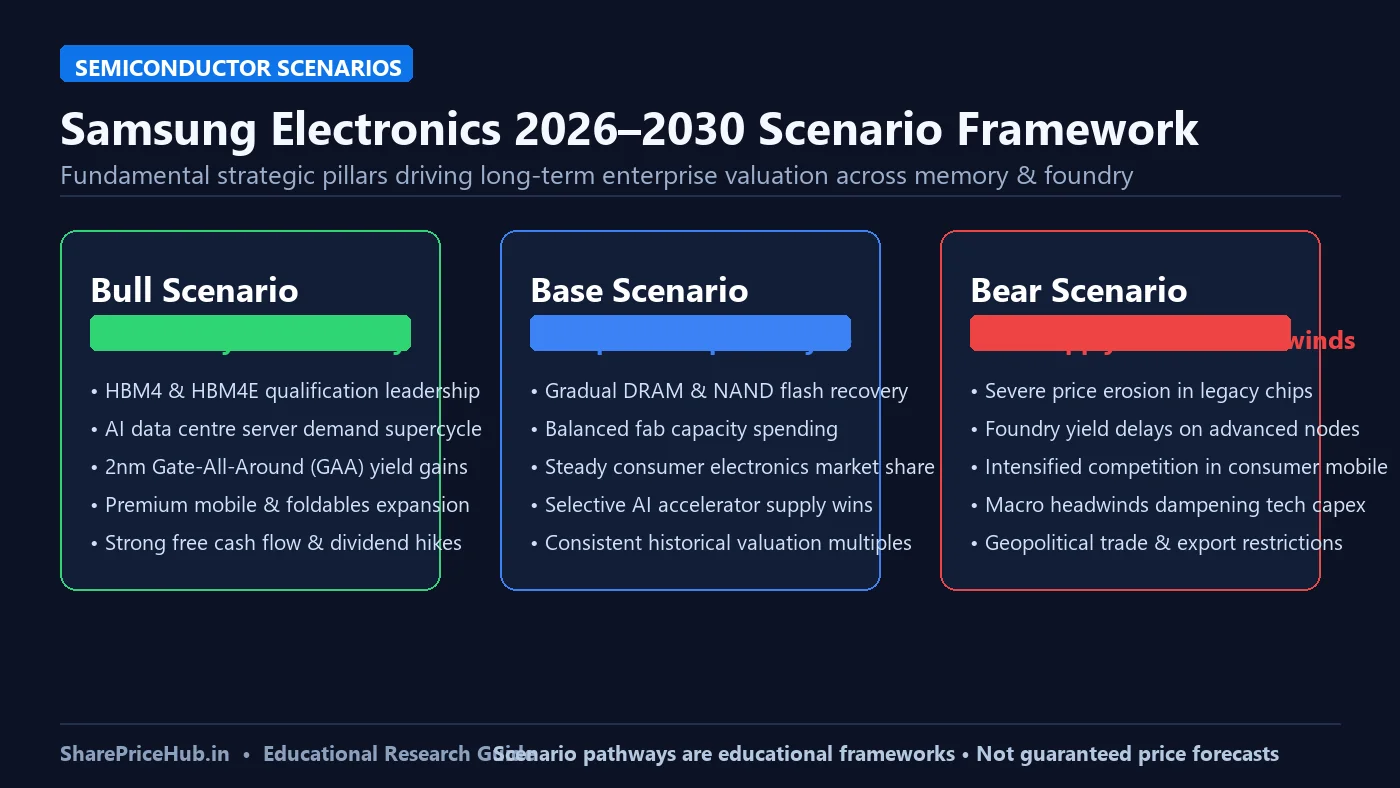
| Scenario | Business conditions | Possible share-price implication | What would confirm or weaken it |
|---|---|---|---|
| Bull case | AI and server demand stay strong; high-value memory products scale; foundry execution improves; mobile profits remain healthy | Earnings and valuation could both improve | Strong cash flow, resilient margins, product leadership and good factory utilisation |
| Base case | AI demand grows but supply cycles and normal competition continue; other divisions deliver mixed results | Returns follow earnings growth more closely, with ups and downs | Stable margins, controlled spending and no major market-share loss |
| Bear case | Memory oversupply, price declines, costly execution problems or weaker devices reduce profit | Earnings estimates and valuation multiples could fall | Falling memory prices, lower factory utilisation, rising costs and weak cash conversion |
This table is a reasoning framework rather than an investment forecast. It does not assign an invented target price or a precise probability to each case. Investors who want a numerical model should build one from updated earnings estimates, net cash and debt, shares outstanding, market price and an explicit valuation method. Each assumption must be visible so the model can be changed when evidence changes.
Samsung stock price target: how to read analyst estimates
An analyst price target is an estimate based on a model, not a promise. Analysts may use different earnings forecasts, valuation multiples, discount rates and time horizons. They may also update targets after the market price moves, so a high target can partly reflect a new earnings outlook rather than a guaranteed amount of upside. Compare the date of the target with the current price and check whether it is for the ordinary Korean share, preferred share or a depositary receipt.
A third-party analyst-consensus page on Investing.com viewed on 29 October 2026 showed a wide range of estimates and a bullish aggregate rating. Such snapshots can move quickly, and different providers may include different numbers of analysts or use different update rules. Before publishing a specific average target, record the provider, data date, low and high estimates, sample size and currency. If the provider does not clearly show those elements, avoid claiming that a target represents “the market” as a whole.
Do not calculate potential upside from a target without checking the baseline quote. The formula is (target price − current price) ÷ current price × 100. If the quote is delayed, in another share class or in another currency, the result can be misleading. A target based on the Korean ordinary share cannot be copied directly onto a London GDR without considering the depositary ratio and currency conversion.
Samsung stock price USD and EUR: which instrument are you checking?
Samsung Electronics shares are primarily quoted in Korean won. Investors may also encounter London-listed GDRs that trade in a different currency environment. A Samsung stock price USD query may refer to a USD value converted from the Korean share, a GDR quote, or an online platform’s representation. A Samsung stock price EUR query may simply be a currency conversion rather than a separate listing in euros. Always identify the underlying share and market before comparing prices.
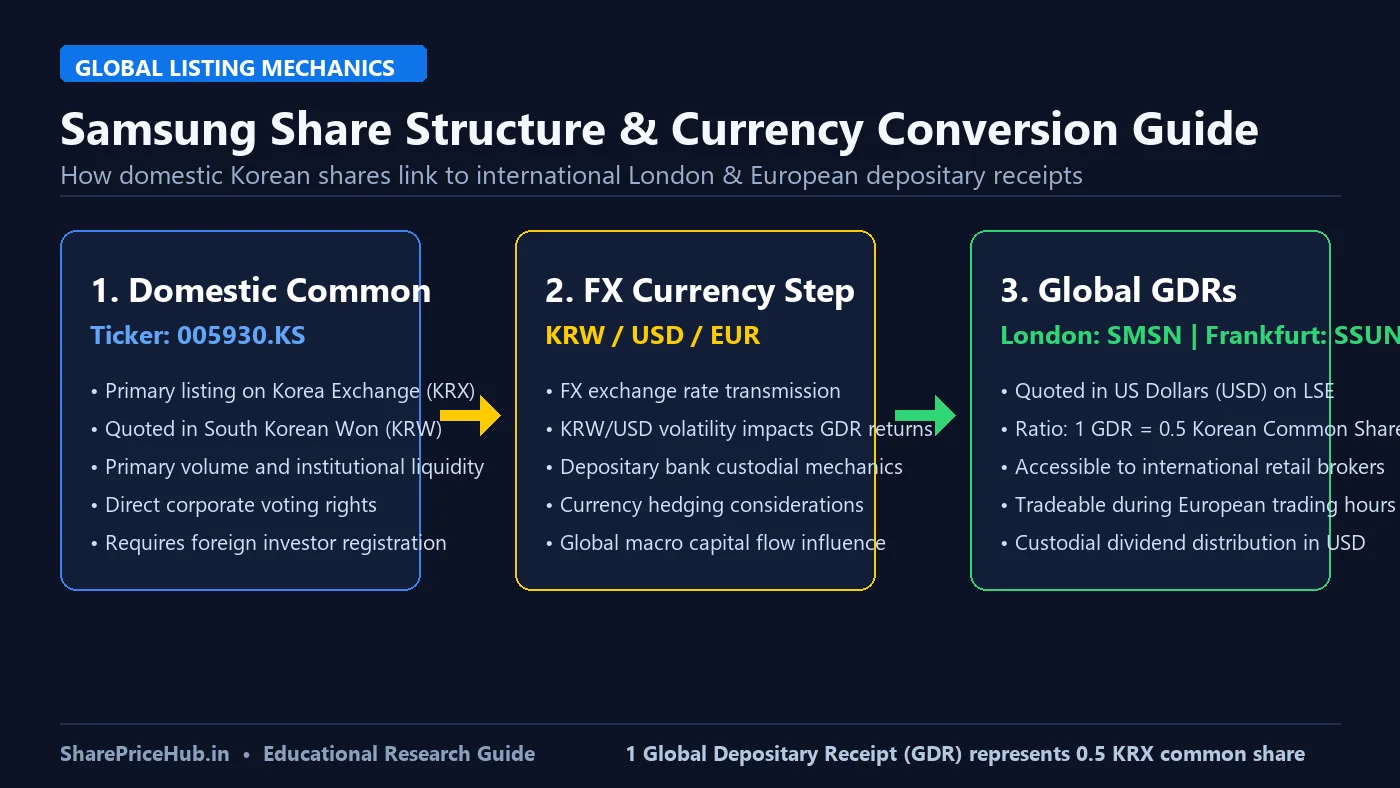
The basic conversion is: price in target currency = local share price × current exchange rate, adjusted for the unit represented by the instrument. This simple formula does not account for brokerage fees, taxes, market spreads or the depositary ratio of a GDR. Currency rates move during the day, so a converted value may differ from the quote displayed by a broker.
For a Samsung stock forecast USD, investors based in the United States should assess both the Korean share’s local return and the movement of the won against the dollar, or the relevant GDR’s own quote. European investors should do the same with the euro. A share can rise in Korean won but deliver a smaller return in another currency if the won weakens. It can also deliver a larger converted return if the currency strengthens. Do not put a fixed USD or EUR price in the article without a dated FX source.
Does Samsung stock trade on Nasdaq?
The company’s official listing information says Samsung Electronics’ original shares are listed on the Korea Exchange, with common shares under ticker 005930 and preferred shares under 005935. It also lists common GDR ticker SMSN and preferred GDR ticker SMSEL on the London Stock Exchange. It does not identify Samsung Electronics ordinary shares as a Nasdaq listing. Therefore, the keyword “samsung stock Nasdaq” should be answered clearly: check the exact product and ticker before entering a trade, because search pages may combine company names, US market symbols or unrelated securities.
The name “Samsung” can refer to different companies or financial instruments. Samsung Electronics is not the same as every Samsung-branded affiliate. A quote from a trading app may be a contract, a derivative, a depositary receipt or a different company. The legal name, exchange, ticker, currency and security type should be visible on the instrument page. If they do not match the intended asset, do not assume it is the same share.
This is especially important when reading a “buy or sell” summary. A rating written for a Korean ordinary share may not fit a leveraged product or a different listed security. Always read the instrument details and trading conditions first.
Samsung stock buy or sell: a practical decision framework
There is no universal answer to “samsung stock buy or sell” because it depends on valuation, time horizon, portfolio concentration, risk tolerance and the investor’s existing holdings. A long-term investor may focus on business durability and a reasonable entry price. A short-term trader may care more about market momentum, liquidity and upcoming data releases, while accepting a higher risk of loss. Neither approach should rely on one headline or a single analyst target.
Before buying, ask whether expected earnings growth is already reflected in the current price. Look at valuation against a range of future earnings, not only the most optimistic forecast. Check balance-sheet strength, cash flow, capital spending and returns on invested capital. Compare Samsung’s business mix with its competitors and consider whether one division is responsible for most of the recent growth.
Before selling, ask whether the reason for buying has changed, whether the investment has become too large a share of your portfolio, and whether a short-term fall changes the long-term case. Do not hold a business solely because you want to recover the purchase price; the market does not know your entry price. Equally, do not sell simply because a forecast changes by a small amount. Reassess evidence, risk and personal goals together.
A practical checklist includes: the current quote and currency; latest company results; earnings estimate changes; memory market conditions; customer capital spending; foundry progress; mobile profitability; regulatory and geopolitical risks; and valuation compared with reasonable scenarios. Write down what evidence would cause you to change your view. That discipline is more useful than a firm prediction without supporting assumptions.
CNN, Reddit and other online discussions: how much weight should they get?
People search “samsung stock CNN”, “samsung stock forecast CNN” and “samsung stock prediction Reddit” because they want a quick summary of market opinion. News media can provide context and interviews, while Reddit discussions can reveal questions retail investors are asking. Neither should replace audited results, official filings or a clear valuation model. A headline may describe an analyst’s view rather than the company’s own guidance, and a Reddit post may reflect one person’s trade, not a verified financial analysis.
When reading an online prediction, identify who made it, when it was posted, what security it refers to, which data it uses and whether the writer discloses a position. Watch for posts promising certain upside, urging an immediate trade, or using screenshots without a visible date. Avoid relying on a single comment or selecting only opinions that support a view you already hold.
The best use of forums is to build a list of questions. If investors repeatedly mention memory supply, foundry yields, product delays or competition, verify those points in company filings and reliable industry reporting. Treat public opinion as a clue about sentiment, not proof of future performance.
Risks that could change the Samsung stock outlook
Semiconductor cycle: Memory pricing can rise and fall faster than long-term demand forecasts suggest. Earnings can drop sharply when supply catches up with demand.
Execution and technology: Advanced memory products and foundry processes require high investment and reliable yields. Delays can raise cost and affect customer confidence.
Competition: Other chipmakers can gain share, develop competing technologies or expand capacity. A leader today may face different economics later.
Customer concentration: Large cloud, device and industrial customers have bargaining power and may change orders, product requirements or timing.
Consumer electronics: Smartphone, television and appliance sales are sensitive to household spending, component costs and product cycles.
Regulation and geopolitics: Export rules, trade restrictions, regional tension and supply-chain changes can affect access to customers and technology.
Currency: A KRW return may differ from a USD or EUR return for overseas investors.
Valuation: Even a strong company can be a poor investment if bought at a price that assumes flawless results for many years.
Forecast error: Long-term targets rely on assumptions that can quickly become outdated when demand, costs and competition change.
How to monitor Samsung through 2026, 2027 and 2030
A useful monitoring plan does not require watching every price tick. Review each quarterly earnings release and compare reported performance with the company’s earlier guidance. Track segment revenues and operating profits, not just total revenue. For semiconductors, watch memory pricing, AI-related demand, high-bandwidth memory progress, server DRAM and SSD sales, factory investment and capacity. For mobile devices, watch premium-device mix, component costs, launch performance and operating margins.
Keep a record of analyst-estimate changes, but do not treat a consensus target as a guaranteed future price. For another memory-chip business outlook, see our Micron stock prediction. You can also compare other global technology shares in our PayPal stock prediction and Unity Software stock outlook. Mark the date of each target and compare it with the share price at that time. If the share rallies strongly before earnings, expectations may be demanding. If the price falls despite good results, ask whether the results were already expected or whether management’s forward comments changed the outlook.
For a 2030 horizon, revisit the investment thesis every year. Ask whether Samsung remains competitive in the products that generate its profits, whether it is earning enough on capital spending, and whether a change in technology makes the current business mix less valuable. The purpose of monitoring is not to produce a new exact price every week; it is to notice meaningful changes in the business case.
Frequently asked questions
What is the Samsung stock prediction for 2026?
Samsung’s latest results on 29 October 2026 showed record quarterly revenue and strong semiconductor profit. The outlook depends on AI memory demand, pricing, execution, consumer products and valuation; no future share price is guaranteed.
What is the Samsung stock prediction for 2027?
A 2027 view should track whether AI-related demand and memory earnings stay strong while new capacity, competition and capital costs are managed. Use bull, base and bear scenarios rather than a single promise.
What is the Samsung stock prediction for 2030?
A 2030 target is highly uncertain. Build scenarios from future earnings, cash flow and valuation assumptions and update them as evidence changes.
Was Samsung stock prediction 2025 a current forecast?
No. In October 2026, 2025 is historical. Old predictions should be evaluated against actual outcomes and clearly labelled with their original dates.
What is the Samsung stock price target?
Price targets vary by analyst and date. The article should include a target only with a named data source, timestamp, currency and forecast range.
Can I find Samsung stock price in USD or EUR?
Yes, depending on the platform and instrument, but you must distinguish a converted Korean share price from an actual GDR quote and include the currency-exchange date.
Is Samsung stock listed on Nasdaq?
Samsung Electronics’ official listing information identifies KRX ordinary shares and London Stock Exchange GDRs. Check the actual exchange and ticker in your broker rather than assuming a Nasdaq listing.
Should I buy or sell Samsung stock?
That depends on your price, time horizon, portfolio, risk tolerance and view of future earnings. This article cannot make a personalised recommendation.
Is Reddit a reliable source for a Samsung stock forecast?
It can show retail sentiment and questions, but forecasts and claims should be verified against official company disclosures and reliable data.
What drives Samsung’s share price most?
Important factors include semiconductor earnings, memory prices, AI infrastructure spending, foundry execution, mobile margins, global demand, currency rates and valuation.
Conclusion
Samsung’s outlook for 2026–2030 should be built around earnings quality, semiconductor-cycle risk, AI demand, capital spending and valuation. The official Q3 2026 report provides important evidence, but it does not remove uncertainty. Confirm whether you are looking at KRX ticker 005930, a preferred share or a London GDR, and use the matching currency and quote. Treat analyst targets, CNN headlines and Reddit posts as inputs rather than proof. A well-researched stock forecast explains assumptions and risks, updates quickly when the facts change, and never presents an uncertain price as a guaranteed outcome.
Extra Samsung stock forecast questions
What can a Samsung stock forecast 2030 tell investors?
A Samsung stock forecast 2030 is a scenario for how earnings, margins, memory-chip demand, competition, currency and valuation might affect the share price over time. It is not a known future price. Review the assumptions and downside case rather than treating a target as a promise.
What is meant by a Samsung shares prediction?
A Samsung shares prediction is an estimate of possible future performance. It should identify the exact security and exchange, explain the time horizon, and separate company facts from estimates. Samsung Electronics trades primarily in South Korea, so readers should not assume that a Nasdaq search phrase refers to a directly listed Samsung Electronics share on Nasdaq.
Disclaimer
This article is general educational information, not personal financial advice or a recommendation to buy or sell a security. Stock prices can fall, analyst forecasts can be wrong, and currency movements can change returns. Verify the latest company disclosures and market data before making a decision.