
A Bombay High Court ruling dated 19 October 2026 has delivered a landmark epfo higher pension private sector verdict, giving relief to private-sector employees whose higher-pension applications were rejected because of their employers’ provident-fund trust rules. The Court directed EPFO to process and allow the petitioners’ joint-option applications within eight weeks.
But does this mean every private-sector employee can now claim a higher pension? No. The ruling concerns specific cases, and eligibility still depends on the applicable pension rules and each employee’s records. Here is what the judgment says, why it matters, and what affected applicants should check next.
- The Big Court Decision: The Bombay High Court cancelled EPFO rejection orders for workers whose companies run their own private PF trusts (Amit Gunvantrai Mehta v. EPFO).
- The 8-Week Order: EPFO officers must verify and allow the petitioners’ joint options within 8 weeks.
- The Golden Rule: This order helps people whose past forms were rejected. It does not open a new window for people who never applied before July 2023.

Table of Contents
- 1. EPFO Higher Pension Verdict: Latest Update at a Glance
- 2. What Is the Latest EPFO Higher Pension Private Sector Verdict?
- 3. Why Did EPFO Reject Higher-Pension Applications for Exempted Trust Employees?
- 4. What Exactly Did the Bombay High Court Order in October 2026?
- 5. Does the Verdict Apply to All Private-Sector Employees?
- 6. What Did the Supreme Court Decide in November 2022?
- 7. Current EPFO Higher-Pension Rules & Joint Option Requirements
- 8. What Has Changed in the EPF and EPS Scheme Rules?
- 9. Is the Higher-Pension Application Window Open Again?
- 10. Who May Benefit From the Latest Verdict?
- 11. What Should You Do If EPFO Rejected Your Higher-Pension Application?
- 12. Video Explainer: Higher Pension Calculation & Ground Reality
- 13. How to Find & Download the Court Judgment PDF
- 14. Is There a New Supreme Court Case on Higher Pension?
- 15. Frequently Asked Questions (FAQs)
- 16. Official Sources, Verification Methodology & Legal Disclaimer
1. EPFO Higher Pension Verdict: Latest Update at a Glance
Here is a clean and simple summary table of the court decision so you can read all important facts in one minute:
| Important Fact | Official Status |
|---|---|
| Which Court Gave the Order? | Bombay High Court (Single Bench of Justice Sandeep V. Marne) |
| Order Date | 19 October 2026 (Writ Petition No. 13752 of 2026) |
| Main Court Case | Amit Gunvantrai Mehta v. Employees’ Provident Fund Organisation (EPFO) |
| What Was the Problem? | EPFO rejected higher pension forms saying private PF trust rules did not allow extra contributions. |
| What Did the Judge Order? | EPFO’s rejection letters are cancelled. EPFO must process and allow petitioners’ joint options within 8 weeks. |
| Who Gets Direct Relief? | Workers and pensioners who filed these court petitions (from Abbott India, Raymond Steel, Tata Communications, BEST, etc.). |
| Can Anyone Apply Fresh Today? | No. The online window closed on 11 July 2023. This order is only for people who already applied in time. |
| Did Salary Limit Change? | The official EPS limit is still ₹15,000 per month. A proposal to raise it to ₹21,000–₹25,000 is not yet notified by government. |
| Information Checked On | 25 October 2026 |
2. What Is the Latest EPFO Higher Pension Private Sector Verdict?
On 19 October 2026, the Bombay High Court gave a very important ruling. A group of private-sector workers and retired staff had filed court cases because regional EPFO offices had rejected their joint-option applications for a higher monthly pension.
This big epfo higher pension private sector verdict dealt with companies that manage their own internal PF trusts (called “exempted establishments”). In these companies, your monthly provident fund savings are managed by your company’s trust. But your monthly pension scheme (EPS-95) is still managed directly by EPFO. When these employees applied to receive pension on their real salary instead of the small ₹15,000 limit, EPFO rejected them, pointing to clauses inside their private trust books.
Justice Sandeep V. Marne ruled that EPFO was wrong. The court explained that an internal company trust deed cannot cancel your statutory pension rights given under Indian law and the landmark 2022 Supreme Court ruling.
3. Why Did EPFO Reject Higher-Pension Applications for Exempted Trust Employees?
To understand why this court fight happened, look at how your monthly PF money is split:
- The Basic 8.33% Cut: Every month, your employer puts 12% into your PF. Out of that, 8.33% goes into the EPS pension pool, but by default it is capped at ₹1,250 (which is 8.33% of ₹15,000). The rest goes into your PF savings.
- The Higher Pension Option: When you choose higher pension, you agree that 8.33% of your real, full salary (like ₹75,000 or ₹1,20,000) should go into the pension pool, and the past extra money is moved from your PF savings.
- Why EPFO Said No: EPFO officers said that because the company’s private trust rules only mentioned the ₹15,000 limit, the employer had no right to sign a higher pension form without amending the trust deed first.
The workers told the court that this was unfair. If actual contributions were made on higher wages and the employee is ready to transfer the money to EPFO, EPFO cannot reject them using small technical excuses.
4. What Exactly Did the Bombay High Court Order in October 2026?
In this historic epfo higher pension private sector verdict, the High Court gave very clear directions to EPFO:
The Court’s Final Order: The Bombay High Court cancelled all rejection letters given to the petitioners. The judge ordered EPFO to process and allow their joint-option forms within eight (8) weeks, as long as they meet the standard verification rules.
Here are the 3 main points decided by the court:
- Private Trust Workers Have Equal Rights: Workers whose companies have their own PF trust have the exact same right to higher pension as workers whose PF is deposited directly with EPFO.
- Trust Deeds Cannot Stop Pension: EPFO cannot reject an application just because the company trust deed did not have a special sentence about higher pension.
- Strict 8-Week Time Limit: EPFO officers must finish the paper checks, calculate the money transfer, and issue revised pension orders within 8 weeks.
5. Does the Verdict Apply to All Private-Sector Employees?
No. This ruling does not automatically increase the pension of every private employee in India today. Here is the real situation:
- Direct Relief is for Petitioners: By law, the court’s order directly orders relief for the specific employees who went to court.
- Strong Precedent for Others: Even though it does not work like a magic button for everyone, it creates a solid legal rule across Maharashtra and Goa. Other EPFO offices cannot ignore this legal principle unless a higher court stays the order.
- Only for Past Applications: This order is only for people who submitted their forms before the deadline and got rejected. It does not open the door for people who never applied.
6. What Did the Supreme Court Decide in November 2022?
All higher pension cases in India go back to the landmark Supreme Court ruling on 4 November 2022 in EPFO v. Sunil Kumar B. (2022 INSC 1171). Here is what the top court ordered:
- The 4-Month Window: The Supreme Court gave a 4-month window under Article 142 of the Constitution for eligible employees who joined before 1 September 2014 to apply for higher pension.
- Extra 1.16% Charge Removed: The government tried to charge employees an extra 1.16% from their pocket. The Supreme Court said this was illegal, and this extra money was later taken from the employer’s share instead.
- Equal Treatment for Trust Employees: The Supreme Court clearly said that workers in exempted companies must be treated equally, which paved the way for the 2026 Bombay High Court verdict.
7. Current EPFO Higher-Pension Rules & Joint Option Requirements
Under the official EPFO rules, here is how higher pension eligibility works in plain words:
| Rule | Who is Eligible? |
|---|---|
| Group 1 (Retired before Sep 2014) | Employees who retired before 1 September 2014 and had submitted joint options while working, but were rejected by EPFO. |
| Group 2 (Working on Sep 2014) | Employees who were members of EPS-95 before 1 September 2014 and continued working on or after that date. |
| Who is Not Eligible? | Anyone who joined EPF for the first time on or after 1 September 2014 with a basic salary above ₹15,000 per month cannot join EPS at all. |
| How Money is Transferred | The extra 8.33% difference plus government interest is shifted from your PF balance into the EPS pension account. |
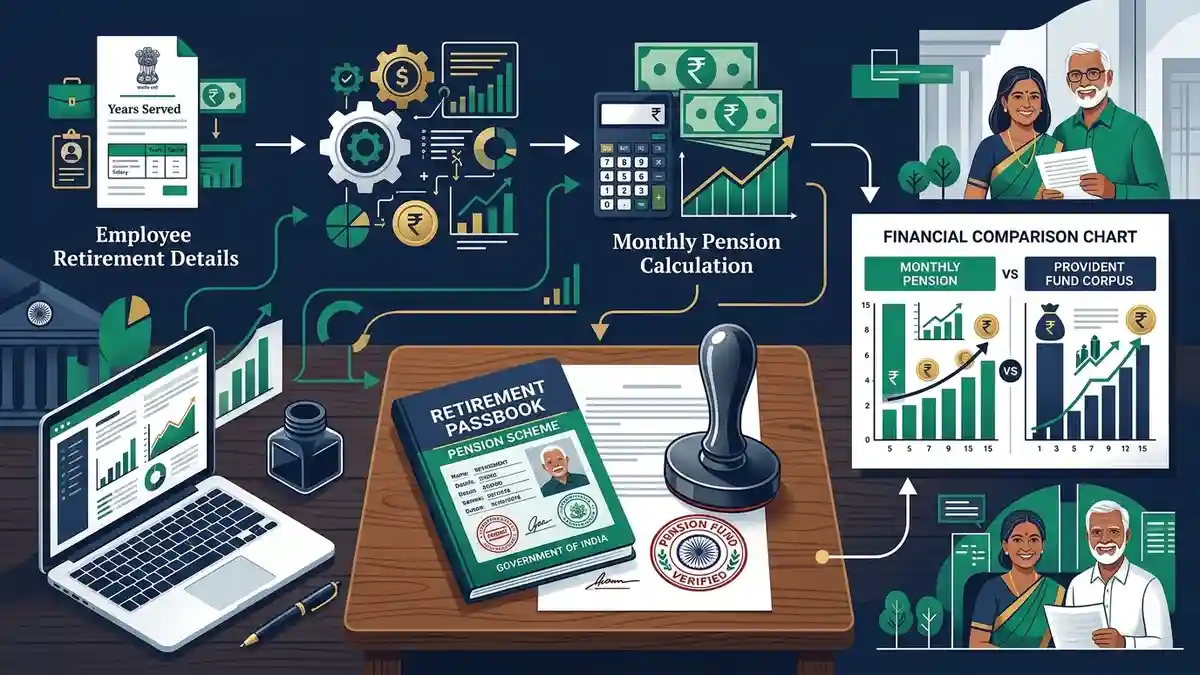
| How Monthly Pension is Calculated | (Average Salary of Last 60 Months × Years of Service) ÷ 70. |
8. What Has Changed in the EPF and EPS Scheme Rules?
Let us clear up the rumors you see on WhatsApp about rule changes:
- Salary Limit is Still ₹15,000: The official salary ceiling for mandatory PF has been ₹15,000 since 2014. While the government has discussed raising it to ₹21,000 or ₹25,000, no official notification has been issued yet.
- Minimum ₹7,500 Pension Rumor: Many worker groups have asked the government to raise the minimum pension from ₹1,000 to ₹7,500. However, the government has stated in Parliament that no such increase has been approved yet.
- Employer Verification: EPFO gave companies multiple date extensions until early 2025 to upload salary proofs for pending applications.
If you track financial institutions that manage digital record-keeping and depository networks in India, you can also read our guide on NSDL share price target and business outlook.
9. Is the Higher-Pension Application Window Open Again?
No. The online portal to submit brand new higher-pension forms is closed.
The joint option application window under the Supreme Court order was open until 11 July 2023. Over 17.4 lakh people applied during that period. The October 2026 Bombay High Court verdict orders EPFO to clear applications that were already filed in time but wrongly rejected. It does not open a new window for fresh applicants.
10. Who May Benefit From the Latest Verdict?
Here is an easy comparison to see if this epfo higher pension private sector verdict helps your situation:
| Your Situation | Does the 2026 Ruling Help You? | What You Should Do |
|---|---|---|
| Petitioner from an Exempted PF Trust | Direct Benefit: Your rejection is cancelled. EPFO has 8 weeks to process your pension. | Take a copy of the court order to your company PF trust and regional EPFO office. |
| Exempted Trust Worker (Rejected, Not in Court) | Strong Precedent: Your rejection on the same ground is legally invalid under this ruling. | Submit a review letter citing the Amit Gunvantrai Mehta judgment. |
| Unexempted Worker with Pending Application | Indirect Help: Shows courts are strictly checking EPFO rejections. | Check your status on the EPFO portal and make sure your company uploaded your salary slips. |
| Missed the July 2023 Deadline | No Immediate Benefit: The ruling does not reopen the expired application window. | Keep your PF savings growing with compound interest in EPF. |
| Joined Service After September 2014 | Ineligible: Barred by the 2014 law upheld by the Supreme Court. | Build your retirement using EPF corpus, NPS, and equity mutual funds. |
11. What Should You Do If EPFO Rejected Your Higher-Pension Application?
If you applied before the July 2023 deadline and received a rejection letter, follow these 6 practical steps:
- Download Your Rejection Letter: Log into the EPFO Member Portal (unifiedportal-mem.epfindia.gov.in) and read the exact reason why EPFO said no.
- Collect Your Old Salary Slips: Gather your salary slips, Form 16, and PF account statements showing that PF was cut on your full real salary.
- Contact Your Company HR / PF Trust: Ask your company HR to give you a certified letter stating that full employer PF contributions were made to the company trust.
- Send a Representation Letter to EPFO: Write a polite, formal letter to your Regional PF Commissioner. Attach your application receipt, salary proofs, and mention the Bombay High Court ruling in Amit Gunvantrai Mehta v. EPFO (Writ Petition No. 13752 of 2026).
- File an Online Grievance: Log into the EPFiGMS portal (epfigms.gov.in), select “Higher Pension / Joint Option,” and upload your letter.
- Get Legal Advice if Needed: If EPFO still refuses to review your case, speak to a lawyer specializing in labor law about filing a petition before your state High Court.
12. Video Explainer: Higher Pension Calculation & Ground Reality
To see how the pension formula works and understand the trade-off between keeping your PF lump sum versus getting a monthly pension, watch this clear video report by CNBC Awaaz:
13. How to Find & Download the Court Judgment PDF
You can read and download the original, official court order for free directly from the High Court website:
- Go to the Bombay High Court search page: bombayhighcourt.gov.in/bhc/front/unified-search.
- Choose Appellate Side, Principal Seat at Bombay.
- Search by Case Number and enter Writ Petition No. 13752 of 2026, or search by Party Name: Amit Gunvantrai Mehta.
- Select Judgment Date: 19/10/2026.
- Click the case link to download the signed PDF judgment.
You can also read the earlier landmark Supreme Court judgment in EPFO v. Sunil Kumar B. (2022 INSC 1171) on the Supreme Court portal at main.sci.gov.in/judgments.
14. Is There a New Supreme Court Case on Higher Pension?
Many readers wonder if EPFO has challenged this order in the Supreme Court. Here is the verified position:
- EPFO Appeals: EPFO has filed appeals in the Supreme Court against earlier High Court orders regarding old joint declarations. In several cases, the Supreme Court has issued notices without stopping High Court directions.
- Bombay High Court Order Status: The 19 October 2026 judgment in Amit Gunvantrai Mehta is a fresh order with an 8-week deadline. As of late October 2026, there is no stay order against this judgment.
For investors checking manufacturing and industrial trends, you can also review our analysis of Bonfiglioli share price updates.
15. Frequently Asked Questions (FAQs)
Q1: What is the latest EPFO higher-pension private sector verdict?
The Bombay High Court delivered a verdict on 19 October 2026. The judge cancelled EPFO rejection letters issued to private sector workers in companies with their own PF trusts and ordered EPFO to process their joint options within 8 weeks.
Q2: What is the date of the latest higher-pension judgment?
The judgment was passed on 19 October 2026 in Writ Petition No. 13752 of 2026 (Amit Gunvantrai Mehta v. EPFO).
Q3: Does the judgment apply to every private-sector employee in India?
No. The direct order applies to the petitioners in the case. But it sets a strong legal precedent that EPFO cannot reject applications just because of private trust deed rules.
Q4: Is the higher-pension application window open again for fresh applicants?
No. The application window closed on 11 July 2023. The court ruling only covers applications that were already submitted in time.
Q5: What was the Supreme Court’s 2022 judgment on higher pension?
On 4 November 2022, the Supreme Court upheld the 2014 EPS amendment, gave a 4-month window for pre-2014 members to apply, and removed the extra 1.16% employee charge.
Q6: What is the difference between EPF and EPS?
EPF is your retirement savings account where your money earns yearly compound interest. EPS is your monthly pension scheme that pays you a fixed pension every month after retirement.
Q7: What is pension on higher wages?
Normally, monthly pension is capped based on a ₹15,000 salary limit. Pension on higher wages lets eligible members contribute 8.33% of their actual basic salary to receive a much higher monthly pension.
Q8: What should I do if EPFO rejected my higher-pension application?
Download your rejection letter, collect your salary slips, get a letter from your company HR, and send a formal representation letter citing the 2026 Bombay High Court ruling to EPFO.
Q9: How can I download the court judgment PDF?
Visit the Bombay High Court website (bombayhighcourt.gov.in/bhc/front/unified-search), search Case No. WP 13752 of 2026 dated 19/10/2026, and download the PDF file.
Q10: What does the court’s eight-week direction mean?
It means EPFO regional offices are legally required to complete their verification and issue demand notices or pension orders within 8 weeks from the judgment date.
Q11: Can EPFO reject an application because an employer’s PF trust deed does not mention higher pension?
No. The Bombay High Court specifically ruled that company trust deed rules cannot override statutory pension rights under the EPF Act.
Q12: Have the EPF or EPS wage-ceiling rules changed to ₹21,000 or ₹25,000?
No official notification has been published. The salary limit remains ₹15,000 per month.
Q13: What happens to my EPF balance if higher pension is approved?
A large portion of your accumulated EPF savings (the extra 8.33% difference plus past interest) will be transferred from your PF account to the EPS pension fund.
Q14: Are employees who joined service after September 1, 2014, eligible?
Workers who joined EPF after 1 September 2014 with a basic salary above ₹15,000 are not eligible for EPS-95 and cannot get a higher pension.
Q15: How can I check my higher pension application status online?
Go to the EPFO Unified Portal, click on the “Pension on Higher Wages” tracking link, and enter your UAN or Application Reference Number.
16. Official Sources, Verification Methodology & Legal Disclaimer
Official Research Sources Consulted:
- High Court of Judicature at Bombay: Amit Gunvantrai Mehta v. EPFO (Writ Petition No. 13752 of 2026, Order dated 19 October 2026). Portal: bombayhighcourt.gov.in
- Supreme Court of India: EPFO v. Sunil Kumar B. (2022 INSC 1171, Judgment dated 04 November 2022). Portal: main.sci.gov.in
- Employees’ Provident Fund Organisation (EPFO): Official circulars and member instructions. Portal: epfindia.gov.in
- Ministry of Labour & Employment, Government of India: Official Press Information Bureau (PIB) releases and Parliamentary replies.
Legal Disclaimer: This article is written for educational and informational purposes based on official court orders and statutory notifications as of 25 October 2026. It is not personal legal or financial advice. Pension eligibility depends on your employment records, contribution history, and court orders. For legal disputes, consult a qualified labor law advocate or pension consultant.