
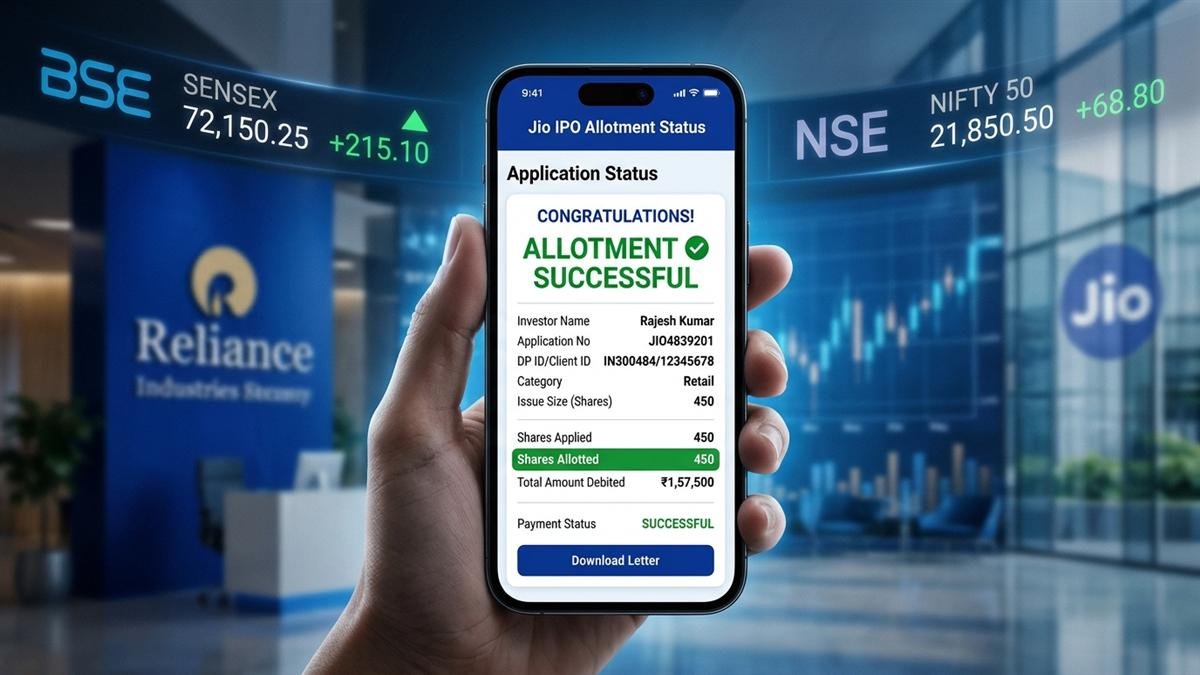
The Jio Platforms IPO has already completed its allotment and listing process. The issue closed on 23 October 2026, the basis of allotment was finalised on 26 October, refunds and share credit were scheduled for 27 October, and trading began on 28 October 2026. This guide explains how applicants can check their application result and how the process worked.
The Jio IPO allotment status can be checked through the appointed registrar, KFin Technologies, or the official exchange services. Use the official portal only. Never share your PAN, OTP, UPI PIN, bank password or demat login with a person who says they can check the result for you.
Key Takeaways
- Jio Platforms IPO bidding closed on 23 October 2026.
- The basis of allotment was finalised on 26 October 2026.
- Refunds or UPI unblocking and demat credit were scheduled for 27 October 2026.
- The shares were listed on NSE and BSE on 28 October 2026.
- The issue price was ₹1,119 per share, and the reported BSE listing price was ₹1,358.
- KFin Technologies was the registrar. The official status portal is ipostatus.kfintech.com.
Jio Platforms IPO Allotment: Important Dates
| IPO event | Date / details |
|---|---|
| Issue opened | 21 October 2026 |
| Issue closed | 23 October 2026 |
| Basis of allotment | 26 October 2026 |
| Refund initiation / UPI unblock | 27 October 2026 |
| Shares credited to demat accounts | 27 October 2026 |
| Listing on NSE and BSE | 28 October 2026 |
| Issue price | ₹1,119 per share |
| Lot size | 12 shares |
| Registrar | KFin Technologies Limited |
The public issue was subscribed about 22.19 times overall, based on the reported final bidding data. Demand differed across investor groups. A high subscription level means applications exceeded the shares available in a category. It does not guarantee that every applicant receives shares.
What Does IPO Allotment Status Mean?
An IPO is an initial public offering. It is the process through which a company offers shares to investors before or when it first lists on a stock exchange. When an investor applies, the application is recorded under details such as PAN, application number and demat account information.
After the issue closes, the registrar helps reconcile valid applications and the number of shares available in each investor category. The basis of allotment explains how shares are distributed. If a category receives more applications than the shares reserved for it, not every applicant can receive the full number of shares requested.
The allotment result tells an applicant how many shares, if any, were assigned to the application. It is different from the stock exchange listing price. Allotment tells you whether shares were allocated. Listing tells you the price at which the shares begin trading in the market. An applicant can receive shares and still face a loss if the market price later falls below the issue price.
The registrar is appointed for each IPO. KFin Technologies is the registrar for the Jio Platforms issue, but it is not the registrar for every IPO in India. Some companies appoint MUFG Intime India, Bigshare Services or another registered registrar. Always check the appointed registrar in the offer documents or exchange notice before entering personal information.
How to Check Jio IPO Allotment Status Online by PAN
KFin Technologies was appointed as the registrar for the Jio Platforms IPO. The registrar processes application records, supports the allotment process and provides an application-result service. Follow these steps if the historical issue is still available in the portal:
- Open the official KFintech IPO Status portal.
- Choose Jio Platforms Limited if the issue appears in the portal’s list.
- Select the search method displayed by the portal, such as PAN, application number or demat account details.
- Enter only the details required for that method. Check each character carefully before submitting.
- Complete the security check, such as a captcha, if the portal asks for one.
- Submit the form and read the result shown on the official page.
- Save or note the result for your own records, but do not post personal details in a public comment or forum.
Because the Jio Platforms issue is already listed, it may no longer appear in the same way as a newly closed IPO. If you cannot find it in the drop-down list, use your allotment message or the demat statement from the time of the issue. Do not assume that the issue is still waiting for allotment just because the old IPO is not visible in the current portal.
How to Check Jio IPO Status Using an Application Number
Some applicants prefer to use the application number rather than PAN. This number is usually shown in the confirmation message, email or application record from the broker, bank or online IPO platform.
- Find the Jio Platforms IPO application number in the confirmation from your bank or broker.
- Open the official KFintech status page.
- Select Jio Platforms Limited if the issue is still available.
- Choose Application Number or the corresponding option shown on the portal.
- Enter the application number exactly as recorded. Do not add spaces unless the portal asks you to.
- Complete the captcha or security step and submit the request.
If the application is not found, first check that you selected the correct IPO and entered the correct number. Some applications are submitted through ASBA and others through a UPI-based process. If the number still does not appear, check the confirmation from your broker or bank and contact the registrar through its official support route.
How to Check Jio IPO Status Using Demat Details
A demat account is an electronic account that holds shares. It is maintained through a depository participant and one of India’s two depositories, NSDL or CDSL. Some registrar portals allow applicants to search using demat account information.
- NSDL: The account normally uses a DP ID and Client ID.
- CDSL: The account normally uses a 16-digit Beneficiary Owner Identification number, often called a BO ID.
Use the exact format requested by the registrar’s page. Do not publish a demat account number in a comment, message board or social-media post. If you are unsure which account was used for the IPO, check the application confirmation or ask your broker using its official app or website.
How to Check Jio IPO Application Status on BSE
BSE provides an online IPO application status service for issues that appear in its system. To use it:
- Go to the official BSE IPO Application Status page.
- Choose the relevant issue type and select Jio Platforms Limited if it is available.
- Choose the identification method supported on the page.
- Enter the requested application or PAN details.
- Submit the form and read the result.
Use the official BSE website rather than a copied page or a social-media link. The exchange’s application service may not retain every historical IPO in its current issue list.
How to Check Jio IPO Bid Information on NSE
NSE’s IPO bid verification service can help an applicant check information received from the broker or exchange system. Open the official NSE IPO Bid Verification page and follow the sign-in and issue-selection instructions shown there.
Bid verification and final allotment are not exactly the same thing. The exchange service helps confirm bidding information in its system. The registrar’s basis of allotment and the final demat credit confirm whether shares were allotted to an applicant.
What Was the Final Jio Platforms IPO Subscription?
The Jio Platforms IPO closed on 23 October 2026. The reported overall subscription was 22.19 times. The category-wise figures reported in the final issue-period data were:
| Investor group | Reported subscription |
|---|---|
| Qualified institutional buyers (excluding anchors) | 70.55x |
| Non-institutional investors | 14.00x |
| Retail individual investors | 2.72x |
| Employee reservation | 2.93x |
| Shareholder reservation | 7.60x |
| Overall | 22.19x |
These figures describe applications received during the bidding period. They are not the number of investors who received shares, and they do not show the return each investor earned after listing.
How Does the IPO Allotment Process Work?
The allotment process is designed to distribute the shares available in each category according to the rules for that IPO. When an issue is heavily oversubscribed, the registrar cannot give every applicant the full quantity requested.
For example, imagine a category has 100,000 shares available and valid applications request 300,000 shares. The demand is three times the number of shares offered. The registrar must apply the allotment rules for that category. In the retail category, where applications are often for one lot, eligible applicants may receive a lot through the applicable allotment method, while others receive no shares. This example is only for explaining oversubscription; it is not the actual Jio Platforms allocation calculation.
The registrar reconciles application data, validates bids and follows the approved basis of allotment. The final allotment can depend on the category, valid applications, number of lots requested and the issue’s specific rules. A person who applied early does not automatically receive priority over someone who applied later within the official bidding window.
It is also important to distinguish an application rejection from zero allotment. An application may be invalid because of an incorrect detail, payment issue, duplicate application or another reason under the issue rules. A valid application may receive zero shares because the category was oversubscribed. The official result and bank or broker record help clarify what happened.
What Happened After Allotment?
Once the basis of allotment was finalised, the registrar and exchange systems processed the next steps. The schedule for this issue was:
- If shares were allotted: the shares were scheduled to be credited to the successful applicant’s demat account on 27 October 2026. The bank or UPI mandate then debited the amount due for the allotted shares.
- If no shares were allotted: the blocked amount was scheduled to be released or unblocked according to the issue timetable.
- If only some shares were allotted: the amount for the allotted shares was debited, and the unused blocked amount was released under the process.
- After listing: investors could see the allotted shares in their demat account and trade them on the exchange, subject to normal market rules.
If you were allotted shares but cannot see them, check the demat account linked with the IPO application and confirm the credit with your broker or depository participant. If money remains blocked after the official timeline, contact your bank or registrar through its official website. Never provide an OTP or UPI PIN to a caller.
What Does Each Allotment Result Mean?
| Result shown | What it usually means | What to check next |
|---|---|---|
| Allotted | Shares were assigned to the application. | Check the number of shares and demat credit. |
| Not allotted / zero allotment | The application did not receive shares in the final distribution. | Check that the blocked amount was released. |
| Application not found | The details may not match the registrar record, or the historical issue may no longer be available on the portal. | Check the application number, PAN, issue selection and broker confirmation. |
| Pending / processing | The portal may not have completed the update or may be displaying a temporary status. | Check the official timeline and try again later. |
These labels are general explanations. The wording on the KFintech portal may differ by issue and system update. Follow the message shown by the official registrar and use your application documents if you need help.
Jio IPO Listing Price: What Actually Happened?
Before listing, some grey-market trackers showed a premium of around ₹247–₹250 over the ₹1,119 issue price. That was an unofficial estimate before trading began. It was not an exchange price and did not guarantee the listing outcome.
The reported BSE listing price was ₹1,358 on 28 October 2026. Compared with the issue price of ₹1,119, this was a difference of ₹239 per share, or about 21.36%. For a 12-share lot, the difference between issue price and listing price would be ₹2,868 before transaction costs, taxes or later price movement, assuming the applicant received the full lot.
The actual listing price was slightly below the ₹1,366–₹1,369 indicative level implied by some of the earlier ₹247–₹250 GMP quotes. This is a clear example of why GMP should never be treated as a guaranteed listing price.
GMP, Issue Price and Listing Price: What Is the Difference?
- Issue price: The price at which investors apply for shares during the IPO. For this issue the price at the top of the band was ₹1,119.
- Grey market premium (GMP): An unofficial indication traded outside the recognised exchange system before listing. It is not a regulated quote and can change quickly.
- Indicative price: A simple calculation that adds GMP to the issue price. It is an estimate, not the price the exchange must use.
- Listing price: The price at which the shares actually begin trading on the exchange. For this issue, the reported BSE listing price was ₹1,358.
GMP can be useful as a rough measure of pre-listing sentiment, but it is incomplete. The actual listing price is influenced by real buy and sell orders, company information, market conditions, liquidity and investor demand. A high GMP does not guarantee a profit, and a low GMP does not guarantee a loss.
Why Is My Jio IPO Allotment Status Not Showing?
There are several possible reasons:
- Issue no longer listed in the drop-down: the IPO has already listed, and the registrar may not show it like a current issue.
- Wrong PAN or application number: compare the details with your broker or bank confirmation.
- Wrong registrar: always check the RHP or official issue information for the registrar appointed to that IPO.
- Technical delay: a portal may be unavailable or may not display historical information after the issue is completed.
- Different demat account: check the account used in the IPO application.
Do not enter personal information into unofficial status-check websites. Use the official registrar, BSE and NSE services, and type the website address carefully.
How to Stay Safe When Checking IPO Status
IPO allotment announcements attract fake websites, social-media accounts and messages that claim to offer early access to results. Follow these safety steps:
- Use the registrar named in the company’s offer documents.
- Check the website address before entering PAN or application details.
- Never share your OTP, UPI PIN, bank password or broker password.
- Do not pay a fee to a person who claims they can improve your allotment chances or release blocked money.
- Do not install a screen-sharing app because an unknown caller asks you to do so.
- For a payment or demat issue, contact your bank, broker or registrar through their official support channel.
A genuine registrar or exchange status check should not need your UPI PIN or bank login password. If someone asks for these details, stop the conversation and contact your bank using the number or support route on its official website.
Frequently Asked Questions
When was the Jio Platforms IPO allotment finalised?
The basis of allotment was finalised on 26 October 2026.
When were Jio IPO refunds and shares credited?
Refund initiation or UPI unblocking and demat credit were scheduled for 27 October 2026.
When did Jio Platforms list on the stock exchange?
The shares were listed on NSE and BSE on 28 October 2026.
What was the Jio Platforms IPO issue price?
The upper issue price was ₹1,119 per share. The lot size was 12 shares.
What was the Jio Platforms IPO listing price?
The reported BSE listing price was ₹1,358 on 28 October 2026, a difference of ₹239 or about 21.36% from the issue price.
Who was the registrar for the Jio Platforms IPO?
KFin Technologies Limited was the registrar. Its official IPO status portal is ipostatus.kfintech.com.
Can I still check my Jio IPO allotment online?
You can try the official registrar or exchange service if the historical issue is still available. If it is not listed there, check the allotment communication and demat statement from the time of the IPO.
Does a high IPO subscription guarantee allotment?
No. A high subscription means that applications exceeded the shares available in a category. The final allotment depends on the basis of allotment and the valid applications in that category.
Does GMP guarantee listing profit?
No. GMP is unofficial and can change before listing. It does not guarantee the exchange price or a profit for any applicant.
What should I do if my allotted shares are missing from my demat account?
Check the account linked to the IPO application and review the allotment confirmation. Contact your broker, depository participant or registrar through an official support channel if the shares still do not appear.
Conclusion
The Jio Platforms IPO has completed its allotment and listing process. The basis of allotment was finalised on 26 October, the refund and demat-credit steps were scheduled for 27 October, and trading began on 28 October 2026. The issue price was ₹1,119, and the reported BSE listing price was ₹1,358.
Use the official KFintech, BSE and NSE portals for application information. Remember that grey-market premium is unofficial and cannot promise a listing price or investment return.
Disclaimer: This article is for general information and education only. It is not a recommendation to buy or sell a security. IPO allotment, listing prices and market returns can differ from estimates. Always check official exchange and registrar information. SharePriceHub is not a SEBI-registered investment adviser.