
Updated 31 October 2026. The Reserve Bank of Australia (RBA) cash rate target is 4.60%, effective from 30 September 2026. The next Board decision is scheduled for 3 November 2026 at 2:30 p.m. Sydney time. The market was pricing in an 80% chance of a rise to 4.85% at the close on 29 October, but this is a futures-based market expectation—not an RBA decision.
Key Takeaways
- The official cash rate target is 4.60%, effective 30 September 2026.
- The next RBA decision is scheduled for 3 November 2026 at 2:30 p.m. Sydney time.
- ASX futures pricing on 29 October implied an 80% chance of a rise to 4.85% at that meeting. This is not an official forecast.
- September 2026 annual CPI inflation was 4.3%; trimmed mean inflation was 3.6%.
- Mortgage and savings rates do not always move by the same amount as the cash rate.
Quick answer: latest RBA cash rate and next meeting
| Item | Dated information checked for this article |
|---|---|
| Official cash rate target | 4.60% |
| Effective date of current target | 30 September 2026 |
| Next scheduled decision in the cited update | 3 November 2026 |
| Market-implied expectation as of 28 October | 80% market-implied chance of a rise to 4.85% at 29 October close, according to ASX Rate Tracker |
| Latest annual CPI | 4.3% annual CPI and 3.6% trimmed mean for September 2026; released 28 October |
| Official source for rate history | RBA Cash Rate Target table |
| Source for market-implied pricing | ASX RBA Rate Tracker |
The Australian Bureau of Statistics released September CPI data on 28 October 2026: annual CPI inflation was 4.3%, up from 4.0% in August, and trimmed mean inflation was 3.6%, up from a revised 3.5%. This is relevant background for the outlook, but it does not mechanically determine the RBA decision. See the ABS September CPI release. The headline facts must be time-stamped. When the RBA releases its next decision, the current rate and forecast section will need an update. Do not leave the October market expectation in place after the 3 November announcement without checking the new result.
What is the RBA cash rate?
The cash rate is the interest rate on unsecured overnight loans between banks. It is a key reference rate in the Australian financial system and is used by the RBA as part of monetary policy. In simple terms, the target helps influence the cost of short-term funding in the banking system. Banks then make their own decisions about mortgage rates, savings rates, business lending, fees and credit standards, taking account of funding costs, competition, risk and commercial goals.
A move in the cash rate can affect household and business decisions, but the effect is not identical for everyone. A borrower with a variable-rate mortgage may see repayments or interest charges change when a lender adjusts its rate. A fixed-rate borrower usually keeps the contracted rate until the fixed period ends, although the cost of refinancing later may be different. A saver may receive a higher rate on some accounts after a hike, but banks do not always pass on the whole change or apply it to every product.
The RBA’s job is not to make every loan cheap. It uses monetary policy to support price stability and sustainable economic activity. Higher rates can reduce spending and borrowing demand, which may help slow inflation over time, but they also increase the pressure on borrowers. Lower rates can support activity when inflation allows, but can also stimulate demand. The Board must weigh several factors rather than responding to one month of data alone.
RBA cash rate forecast: what is the outlook for November 2026?
At the close on 29 October, the ASX RBA Rate Tracker showed market pricing that implied an 80% chance of a rise to 4.85% at the 3 November 2026 meeting. This is useful because futures prices reflect the collective pricing of market participants at a particular time. It is still only an implied probability. It can change quickly when inflation data, employment figures, global prices, currency movements or RBA communications change.
The 80% figure should not be written as “the RBA will raise rates.” A more accurate sentence is: “Market pricing as of 28 October implied a high probability of an increase, but the Board had not yet announced the decision.” The distinction protects readers from confusing market expectations with official policy. If the article is published after the meeting, replace this forecast with the official result and then explain how the decision compared with the previous market view.
The reasons markets expect a move can include persistent inflation, demand that remains stronger than supply, or concern that price pressures may take longer to return to the RBA’s target range. But the final assessment should rely on the RBA’s statement, minutes and the data available at the decision. It is not enough to infer the Board’s reasoning from a futures probability alone.
What could cause an RBA rate hike?
A rate hike becomes more likely when the Board believes demand is too strong relative to the economy’s productive capacity, inflation is not easing as expected, or inflation expectations risk staying elevated. Higher rates raise the cost of borrowing and can encourage households and businesses to save more or delay some spending. That can reduce pressure on prices, although the effect tends to work through the economy with a lag.
Inflation is central, but it is not the only input. The Board may consider services inflation, wage growth, employment conditions, household consumption, housing costs, business investment, productivity, public demand, credit growth and the outlook for global prices. A single high or low data point is rarely the whole story. For example, inflation may slow in one category but remain sticky in services, or a weak retail-sales figure may be offset by a resilient jobs market.
Global developments also matter. Oil, food, freight and import prices can influence Australian inflation. A weaker Australian dollar can make some imported goods more expensive. Yet the RBA must decide whether a price increase is temporary or likely to feed into broader inflation. A supply shock can raise prices while also weakening growth, which makes the policy decision more difficult than a simple “inflation high, rates up” rule.
What could cause an RBA rate cut?
A rate cut may become more likely if inflation is moving sustainably toward the RBA’s target, demand is weakening, job-market conditions soften or the economy needs support. Lower rates can reduce interest costs for variable-rate borrowers, support business investment and make some purchases more affordable. They can also lower interest income for savers, and the benefit to a borrower depends on how much of the change a lender passes through.
A cut does not always mean that the economy is in crisis. It may be a normal adjustment when inflation pressures have eased and the level of restraint is no longer needed. Conversely, a rate cut should not automatically be treated as good news for every share or property price; markets may have already expected it, and other economic concerns may be behind the decision.
The Board also has to consider the risk of cutting too early. If inflation returns or stays high, a premature cut could stimulate demand before price pressures are contained. The RBA may therefore choose to hold rates steady even when some households are under pressure. Policy decisions balance inflation, employment and broader economic conditions over time rather than trying to solve every immediate cost-of-living problem with one move.
RBA cash rate changes: why the decision affects households differently
The same cash-rate change can have different effects depending on the loan contract and household finances. A variable-rate home loan may change after the lender’s repricing date. A fixed-rate loan generally stays unchanged through the fixed period, but a borrower may face a different rate on renewal. Personal loans, business loans and credit cards can follow their own pricing rules, so readers should check the product terms instead of assuming every rate moves by the same amount.
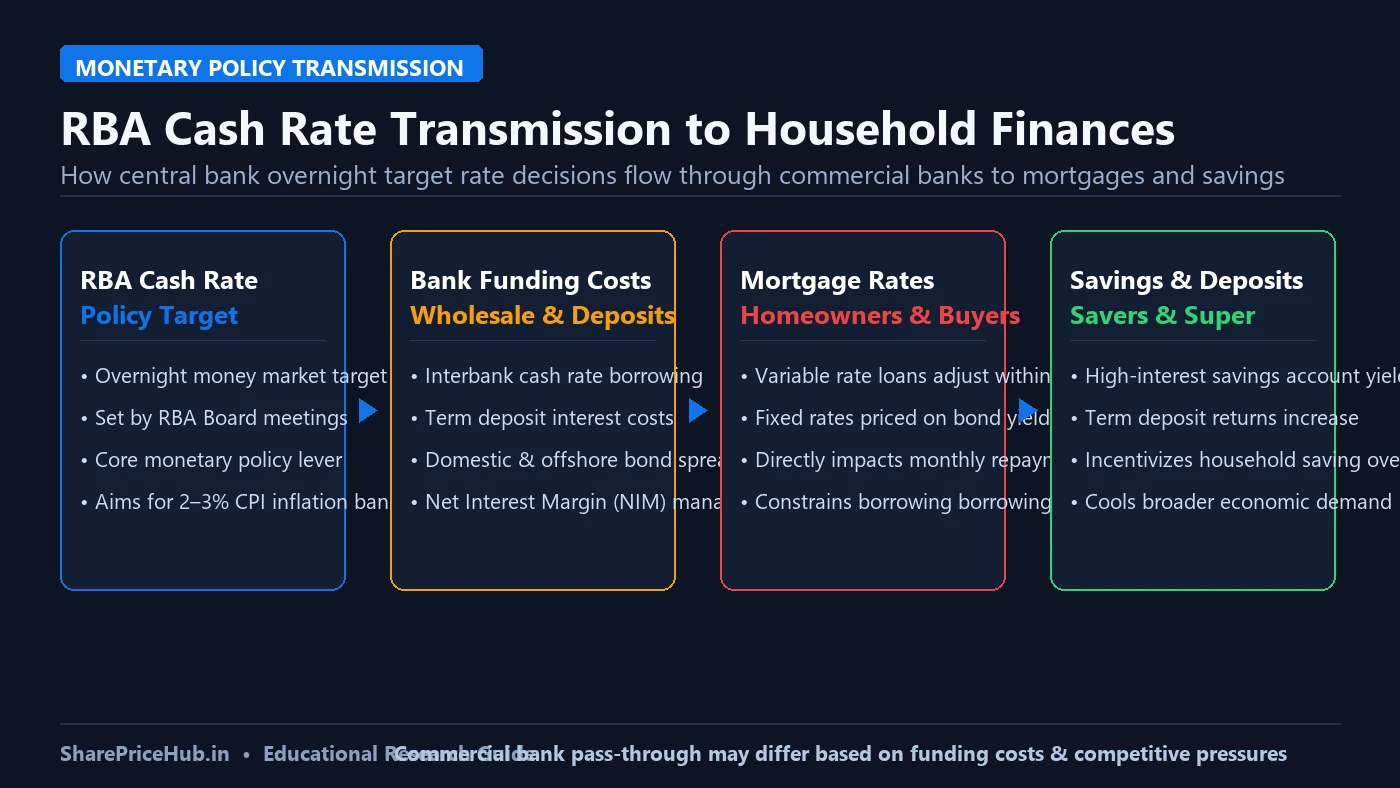
Savers are also affected. Some deposit products may offer better returns after a hike, but the pass-through varies among banks and account types. Promotional savings rates can carry conditions, such as monthly deposits, card purchases or balance caps. Compare the effective rate after those conditions and consider whether you can meet them. For businesses, higher rates can affect working capital, equipment finance, property loans and the return required to approve new projects.
The exchange rate and share markets can react to a decision too, but those moves depend on what was expected. If the RBA does what markets already priced in, the immediate reaction may be modest. If the statement surprises investors, bond yields, the Australian dollar and share prices may move. These changes are not predictable with certainty, and different assets can react in different directions.
RBA historical rate: the 2022 tightening period
The keyword “rba cash rate hike forecast 2022” refers to a past period, not a current forecast. In 2022 the RBA began lifting its target after a long period of very low rates. Official historical data shows the target at 0.10% in early 2022, then increases from May onward. The target moved to 0.35% on 4 May, 0.85% on 8 June, 1.35% on 6 July, 1.85% on 3 August, 2.35% on 7 September, 2.60% on 5 October, 2.85% on 2 November and 3.10% on 7 December 2022.
| Effective date | Cash rate target after the decision | Change |
|---|---|---|
| 4 May 2022 | 0.35% | +0.25 percentage points |
| 8 June 2022 | 0.85% | +0.50 percentage points |
| 6 July 2022 | 1.35% | +0.50 percentage points |
| 3 August 2022 | 1.85% | +0.50 percentage points |
| 7 September 2022 | 2.35% | +0.50 percentage points |
| 5 October 2022 | 2.60% | +0.25 percentage points |
| 2 November 2022 | 2.85% | +0.25 percentage points |
| 7 December 2022 | 3.10% | +0.25 percentage points |
This history helps readers understand how quickly the policy setting can change during a period of rising inflation. It does not mean that the same pattern will repeat in 2026. The economic conditions, inflation outlook, labour market and policy starting point are different. Use past data to understand the policy cycle, not to assume that the next series of changes must match the old one.
RBA cash rate history from 2023 to 2026
After the 2022 tightening phase, changes continued at a different pace. The RBA’s official table records 25-basis-point increases in May and June 2023, followed by a move in November 2023, and then a series of decisions as economic conditions evolved. The exact dates and targets should be pulled from the official cash rate history table when publishing a full interactive chart. A chart needs consistent dates and the target that became effective on each date; it should not mix a decision announcement date with the effective date without explaining the difference.
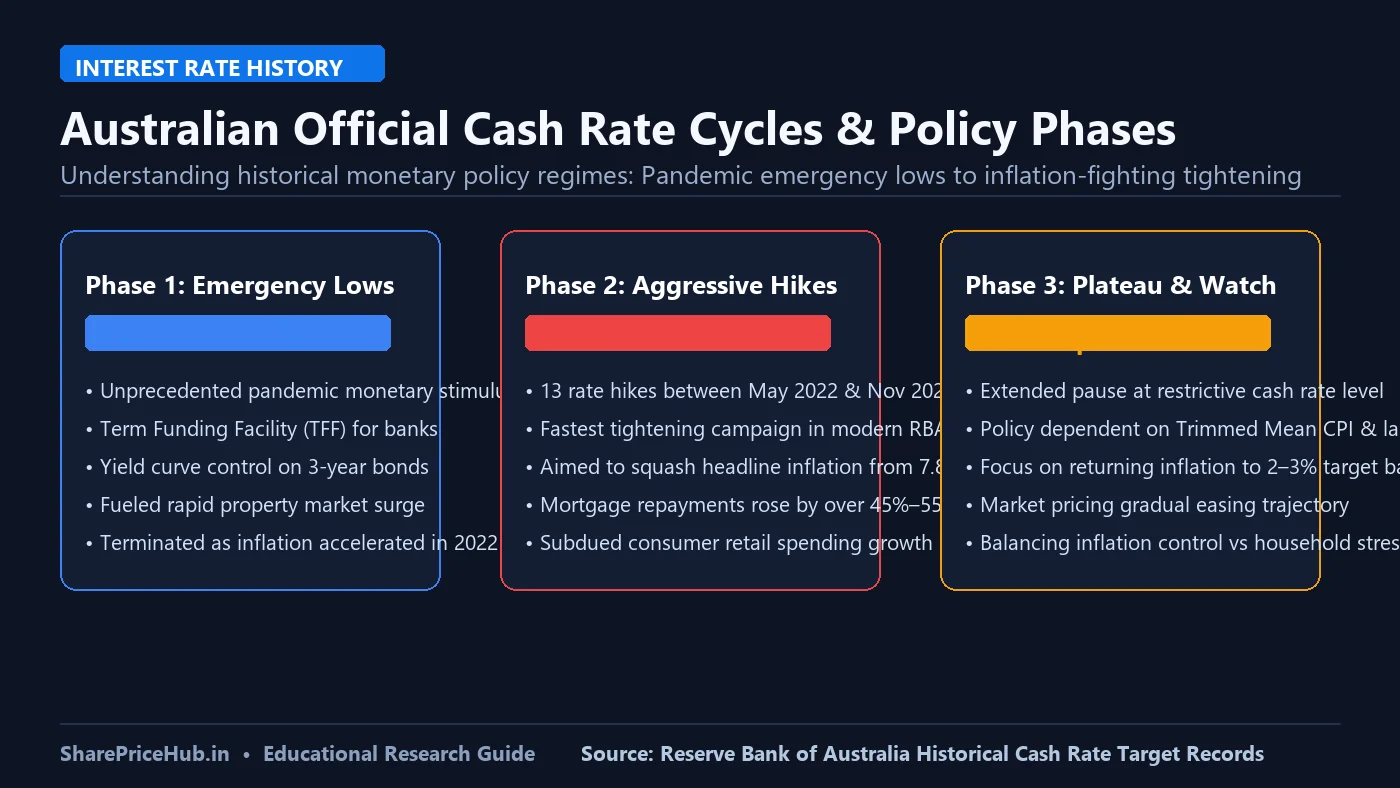
For the 2026 snapshot used here, the target rose to 3.85% on 4 February, 4.10% on 18 March, 4.35% on 6 May and 4.60% on 30 September, according to the RBA’s displayed decision table. It also shows no change at 4.35% in June and August before the September increase. Confirm the complete table and effective dates before publishing because this section will become outdated as soon as the next decision takes effect.
A good historical cash-rate chart should label the y-axis as a percentage, put the effective dates on the x-axis and clearly identify increases, cuts and holds. Explain the main phases in the text. Do not call the series “RBA historical price”: the cash rate is an interest-rate target, not a share price or a commodity price. If you use that awkward search phrase in a FAQ, correct the terminology for the reader.
RBA meeting dates 2026 and the interest rate announcement
The dates of Monetary Policy Board meetings matter because a forecast can become stale immediately after the announcement. The RBA publishes a calendar and releases a statement when the decision is announced. Its cash rate page says the media release is issued at 2:30 p.m. after each Monetary Policy Board meeting, and a change to the cash rate target takes effect the following day. Always verify the current calendar and local time before publishing exact dates, because meeting calendars are periodically updated and the effect date is not necessarily the same day as the announcement.
The RBA cash-rate page identified 3 November 2026 at 2:30 p.m. Sydney time as the next scheduled announcement. In the article’s date-specific context, that is the upcoming event to watch. For a live page, list the next meeting, expected announcement time and official link; once it passes, update the page with the decision and a short explanation. A schedule table should not continue to label a past meeting as “next meeting.”
Readers searching “rba rate statement live” want the official statement as soon as it is released. Link to the RBA media release and cash rate table rather than creating a copied ticker or unofficial live feed. Readers looking for “rba interest rate announcement” should be told that the official RBA page is the primary source, while news sites and financial platforms provide commentary or interpretation.
How to read the RBA rate statement
Start with the decision itself: did the Board raise, cut or hold the target? Then read the reasons given by the Board. Look for references to inflation, the labour market, domestic demand, global conditions, productivity and the outlook for prices. Do not rely on the headline alone. A statement may keep the target unchanged while warning that future policy depends on incoming information; that is not the same as promising no future change.
Next, compare the statement with the previous one. Did the language about inflation become more or less concerned? Did the Board change its view of employment, consumption, housing or global risk? A change in wording can matter for market expectations, but it should be interpreted carefully and in context. It is common for statements to repeat some standard language, so do not infer a major policy shift from one minor wording change.
Then read the published minutes when available. Minutes explain the issues discussed and the reasoning behind the decision in more detail, but they are not a schedule of guaranteed future moves. If the RBA publishes forecasts, read their assumptions and projection period. A forecast is conditional: if new data differs from the assumptions, the outcome can change.
RBA rate hike news and the role of market pricing
Financial news often uses rate-hike probabilities to explain how traders are positioned. The ASX Rate Tracker derives implied expectations from 30-day interbank cash-rate futures. This can be a useful summary of market pricing, but the probability changes as futures prices change. It is not a public vote, an RBA promise or a probability that guarantees the outcome.
The distinction matters in headlines such as “RBA expected to hike” or “cash rate hike forecast.” A responsible story should say who expects a hike, when the expectation was recorded, what data it relies on, and whether the official Board has made a decision. If a market tracker suggests a high chance of an increase, the article should still include the possibility that the RBA holds the rate or makes a different decision.
Avoid turning an analyst estimate into certainty. A rate forecast from a bank economist, a market-implied probability from futures and an official RBA decision are different kinds of information. They can agree, but they can also diverge. Explain the type of evidence so readers understand how much weight to place on it.
RBA interest rate decision and Investing.com searches
Readers who search “rba interest rate decision investing com” may want a quick market calendar or commentary around the decision. Financial data sites can provide a convenient calendar, consensus estimates and market reaction, but the RBA remains the authoritative source for the actual target and statement. If a third-party page shows an expected rate or probability, record the data date and do not call it the official rate.
The official rate page and a market tracker answer different questions. The RBA page tells you the policy target that was decided. A futures tracker estimates how the market is pricing a possible future move. An economist’s forecast gives the view of that person or institution. A news article explains or comments on the decision. An effective page can link to all these categories, but it must label them clearly and avoid mixing them in one column without definitions.
Before publishing a table of forecasts, verify the source, time, currency, instrument and whether the forecast is a percentage change, percentage-point change or probability. These distinctions reduce common errors in finance reporting.
How households can prepare for rate uncertainty
Borrowers should not plan around only one forecast. Run a simple household budget under several possible interest-rate settings: the current rate, a modest rise and a modest fall. The mortgage interest rate is not equal to the cash rate, so use the rate quoted by your lender or a mortgage statement when estimating repayments. Consider whether the household could manage a higher repayment if the lender passes on a cash-rate rise.
If you have a fixed-rate loan that will expire soon, check the renewal date and ask your lender what options are available. Compare the new rate, fees, remaining loan term and any costs from refinancing. Do not assume that a forecast of future rate cuts means it is always best to wait; the right choice depends on loan terms, cash flow, the value of certainty and the rate available today.
Savers should compare the effective interest rate and conditions on deposit accounts. Business owners should model the effect of rate changes on overdrafts, equipment finance and working capital. In each case, avoid overreacting to one headline. A forecast is information for scenario planning, not a replacement for checking the contract and the household’s actual numbers.
Common mistakes when reading the cash-rate outlook
The first mistake is confusing the market forecast with the official decision. A rate tracker may imply a high chance of a hike, but only the Board’s announcement sets the target. The second mistake is assuming the mortgage rate changes by exactly the same number of percentage points as the cash rate. Lenders set customer rates under their own pricing and contract conditions. The third mistake is treating one inflation release as the only factor. The RBA considers a wide set of indicators and the time it takes for policy to affect the economy.
Another mistake is using the old “rba cash rate hike forecast 2022” query as though it describes the current policy outlook. The dates matter. Historical rates can help explain how the policy cycle unfolded, but a present-day forecast must use current data. Finally, do not call a cash-rate chart an “RBA historical price” chart without explaining the term; it is a rate series.
Frequently asked questions
What is the latest RBA cash rate?
The RBA’s displayed target was 4.60%, effective 30 September 2026. Recheck the official cash-rate page after the 3 November Board meeting before publishing a new current figure.
What is the RBA cash rate forecast for November 2026?
At the close on 29 October, ASX futures-based pricing implied an 80% expectation of a rise to 4.85% at the 3 November meeting. That was a market expectation, not an official RBA decision.
When is the next RBA interest rate announcement?
The cited RBA information listed 3 November 2026 as the next scheduled decision. Always confirm the latest official calendar.
What is the difference between a rate hike and a rate cut?
A hike raises the target; a cut lowers it. A hold leaves it unchanged. The effects on individual loans and deposits depend on lender decisions and product terms.
What does “rba historical price” mean?
The cash rate is an interest-rate target, not a market price. Use the official cash-rate history table for past target changes.
How did the cash rate change in 2022?
The RBA raised the target several times from May to December 2022, moving from 0.10% at the start of the period to 3.10% after the December decision.
Does a cash-rate hike immediately increase every mortgage?
Not necessarily. Variable-rate borrowers may see a lender change; fixed-rate borrowers usually keep the contracted rate until the fixed term ends. Check your loan terms.
Is the ASX Rate Tracker an official RBA forecast?
No. It shows market-implied expectations based on futures pricing. The official decision comes from the RBA.
Where can I read the RBA rate statement live?
Use the RBA’s official media-release and cash-rate pages. Third-party sites can add commentary but may not be the primary source.
Will the RBA cut rates in 2026?
No future move is guaranteed. A cut depends on the inflation outlook, demand, employment and other economic conditions considered by the Board.
Conclusion
The RBA cash rate forecast for late 2026 should be treated as a changing assessment, not a promise. The official target stood at 4.60% from 30 September, and market pricing on 28 October implied a high chance of a further rise at the 3 November meeting. The next official announcement will settle the current decision. Follow the RBA statement and historical table for verified rates, and use market trackers only as indicators of expectations. For households, scenario planning and checking the actual loan contract are more useful than relying on a single prediction.
Additional RBA cash-rate search questions
What does “cash rate hike RBA forecast” mean?
A cash rate hike RBA forecast is an estimate of whether the Reserve Bank of Australia may increase its policy rate at a future meeting. It is a forecast, not an announcement. Check the latest official RBA statement and distinguish market expectations from a decision already made.
Where can I find reliable cash rate Australia information?
For cash rate Australia information, begin with the Reserve Bank of Australia’s official cash-rate target and monetary-policy statements. News and comparison sites can help explain the decision, but use the official release for the exact rate and effective date.
How should I interpret an Australia interest rate forecast?
An Australia interest rate forecast may refer to the RBA cash rate, bank lending rates or mortgage rates; these are related but not identical. Always check which rate is being forecast, the forecast date and the assumptions behind it.
Where can I follow RBA news and decisions?
For RBA news, check official media releases and the published meeting calendar first. A search result such as “cash rate hike” or “rate cut” can describe a possibility or an old event, so verify whether the headline refers to a confirmed decision or an analyst’s expectation.
Disclaimer
This article is for general education and does not provide personal financial, mortgage or investment advice. Rate decisions, loan rates and forecasts can change. Verify current data with the RBA, ASX and your financial institution before making a decision.