
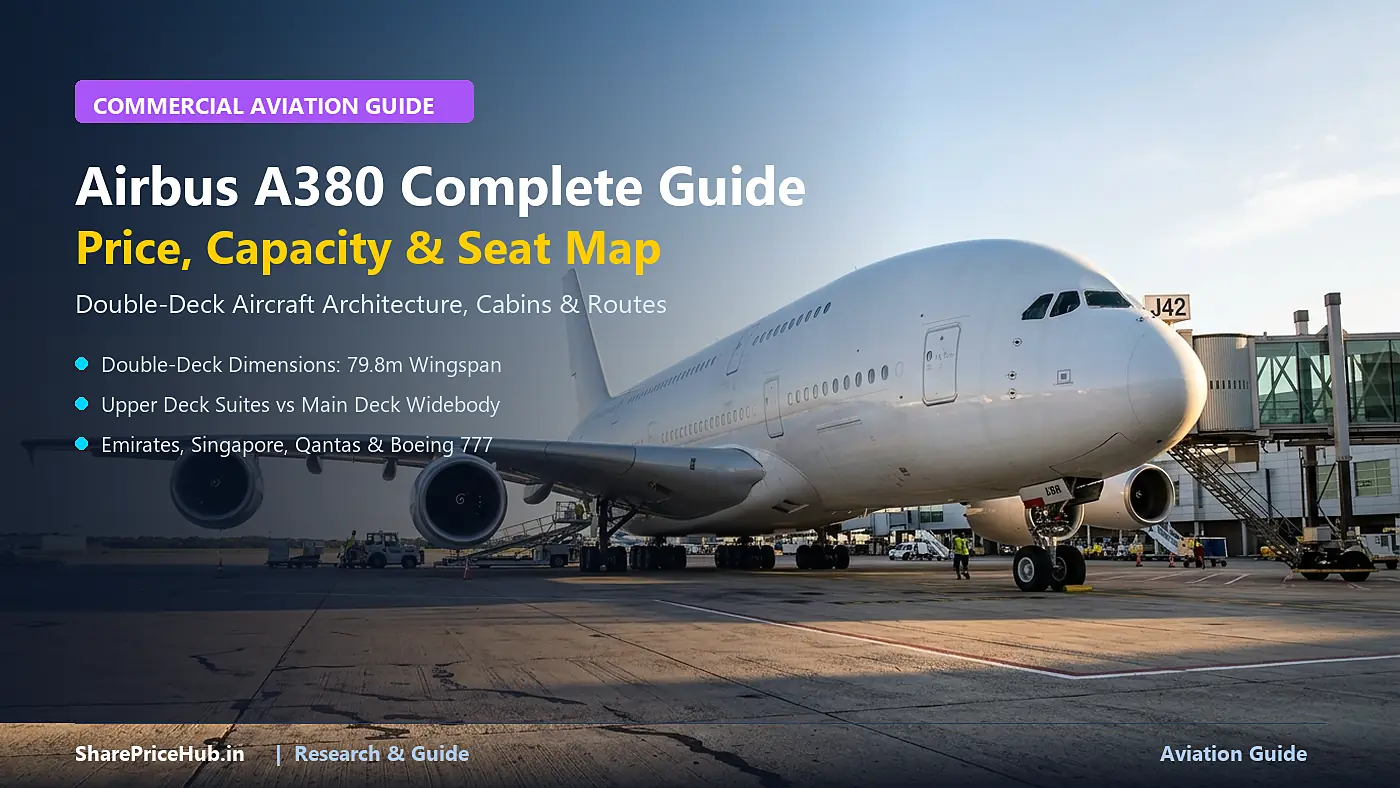
Updated 31 October 2026. Want to know the Airbus A380 price, seating capacity, size or seat map? The A380 is still flown by some airlines, but Airbus no longer builds new aircraft. This guide separates current aircraft facts from old list prices, airline cabin layouts and ticket fares.
Airbus lists 251 A380 deliveries to 14 customers and a maximum certified capacity of 853 passengers. Actual airline seat counts are usually lower because each carrier chooses its own cabin layout.
Key Takeaways
- Airbus has ended A380 production, but continues to support airlines that operate the aircraft.
- Airbus lists 251 aircraft delivered to 14 customers and a maximum seating capacity of 853.
- The A380 has a published range of about 8,000 nautical miles; airline operations and payload affect real-world range.
- The US$445.6 million average list price was a 2018 historical figure, not a current new-aircraft price.
- Ticket prices, seat maps and routes depend on the airline, flight date, cabin and aircraft configuration.
Quick facts about the Airbus A380
| Feature | General information |
|---|---|
| Aircraft type | Four-engine, wide-body, double-deck passenger jet |
| Common model designation | A380-800 |
| Maximum certified seating capacity | 853 passengers; airline layouts are normally lower |
| Passenger deck area | About 550 square metres across the two passenger decks, according to Airbus |
| Range | About 8,000 nautical miles / 14,800 km, according to Airbus |
| Engines | Rolls-Royce Trent 900 or Engine Alliance GP7000, depending on aircraft |
| Total delivered | 251 aircraft to 14 customers, according to Airbus |
| New-aircraft price today | No current new-production list price; production has ended |
| Historical price reference | US$445.6 million average list price published for 2018 |
The official Airbus A380 page is the best starting point for manufacturer specifications; Airbus also provides a technical facts-and-figures PDF with detailed dimensions. For a historical price reference, Airbus’s 2018 average list price PDF lists US$445.6 million and notes that price depends on design weights, engine choice and selected customisation.
Airbus A380 price: how much does the aircraft cost?
The question “Airbus A380 price” needs a date and a type of price. Aircraft prices can mean a manufacturer’s list price, the negotiated amount paid by an airline, the cost of a used aircraft, or the total cost of owning and operating the aircraft over many years. Those numbers are not the same. Airlines may negotiate discounts, financing arrangements, service packages, cabin customisation and multi-aircraft deals. A list price is a reference point rather than proof of what a buyer actually paid.
Airbus’s published 2018 average list price for the A380 was US$445.6 million. This number is useful as historical context, but it should not be presented as the current price of an aircraft available straight from an Airbus production line. The A380 programme’s final delivery was completed, and there is no normal new-build order book for a newly manufactured A380. Any modern transaction involving an A380 is likely to concern an existing aircraft, lease, part-out, refurbishment or another second-hand arrangement, with price depending on the aircraft’s age, maintenance status, engines, cabin and remaining useful life.
A used A380 purchase can also involve heavy additional costs. A buyer may need to inspect structural condition, engine hours and maintenance records; update cabin interiors; complete regulatory checks; arrange crew training; secure spare parts; and plan for maintenance support. The cost of the airframe is only one part of the economics. An aircraft that looks cheap to buy may be expensive to operate if it needs major maintenance or has limited route opportunities.
Airbus A380 price in Indian rupees
The most direct historical conversion starts with Airbus’s 2018 average list price of US$445.6 million. To convert an amount from US dollars into Indian rupees, multiply it by the chosen exchange rate. Since a live foreign-exchange rate changes constantly, the conversion should always show the rate and date used. It is not correct to convert the old list price using an unstated rate and then call the result the A380’s current Indian price.
Illustrative conversion only: if you use an assumed rate of ₹90 for US$1, then US$445.6 million × ₹90 = ₹40,104 million, which equals approximately ₹4,010.4 crore. The ₹90 exchange rate here is a round-number assumption to explain the calculation, not a verified current FX quote. Use the actual conversion rate for the chosen date if you need a financial comparison.
Even the converted figure is not a current quotation. It is a 2018 historical average list price translated using an illustrative rate. An airline’s negotiated price could have been different, and the cost of a used A380 today depends on the aircraft and the deal. For an aviation article, the most transparent wording is: “Airbus listed the A380 at US$445.6 million in 2018; at an illustrative ₹90 per US dollar, that equals about ₹4,010 crore. This is not a current sale price.”
Airbus A380 size and dimensions
The A380 is famous for its enormous footprint and two full passenger decks. Airbus describes about 550 square metres of passenger-deck area across the two decks. The aircraft’s dimensions are commonly listed at roughly 72.7 metres in length, 79.8 metres in wingspan and 24.1 metres in height. Verify the exact dimensions for the aircraft variant and source used before publishing a technical chart, because variant-specific and measurement conventions can matter.
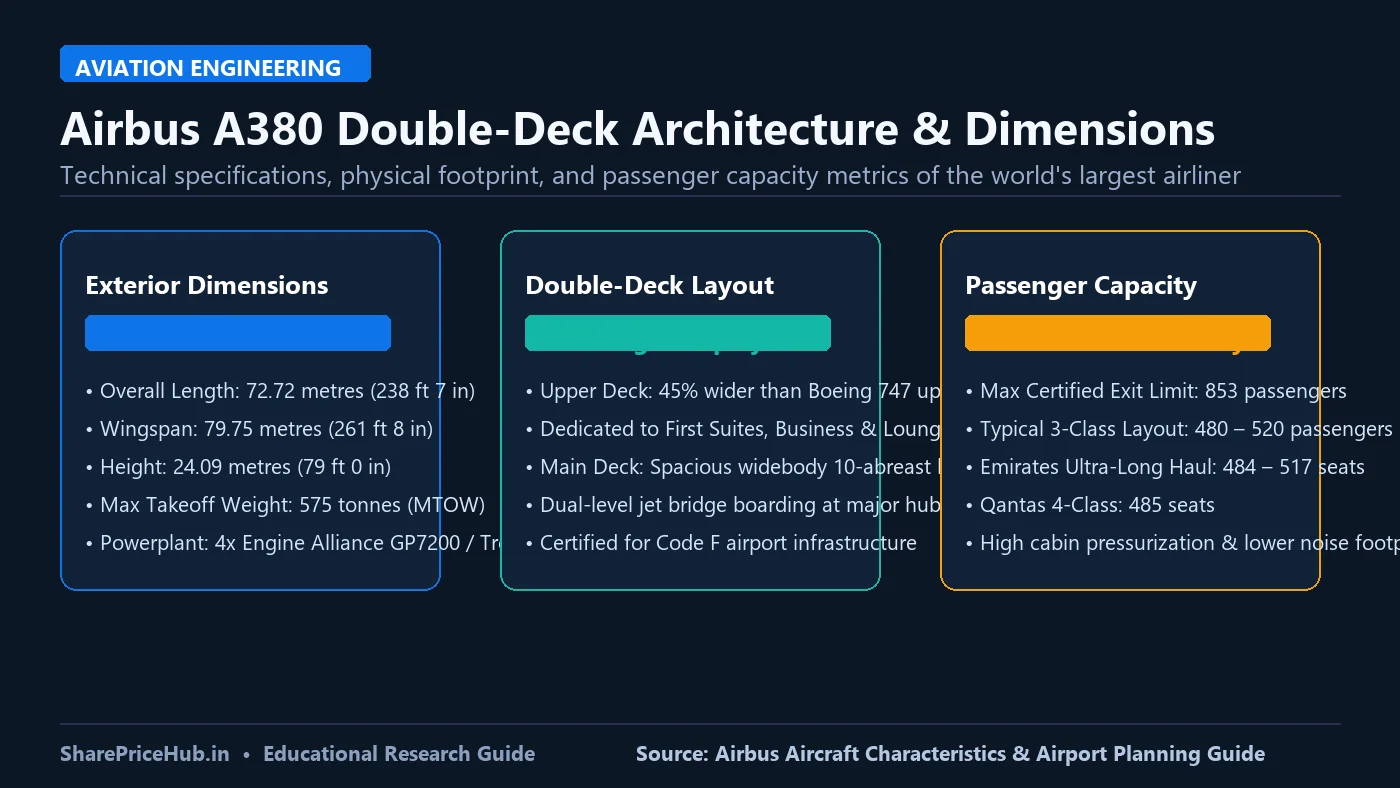
Its large wingspan and weight mean that airports need suitable gates, taxiways, parking stands and ground-handling arrangements. Not every airport can handle an A380 at every gate, and airports may need special passenger boarding bridges and baggage handling processes. Airlines choose routes that can support the aircraft and have enough passenger demand to fill it. A very large aircraft is not automatically the best choice for every route; the airline must balance capacity, fuel, crew, airport infrastructure and passenger demand.
The aircraft’s size creates a different cabin experience from a smaller jet. Passengers can walk along long cabin aisles, aircraft layouts can include multiple cabin classes, and some airlines have used the space for bars, lounges, showers or premium seating. Such facilities depend on the airline’s configuration and should not be assumed to exist on every A380.
Airbus A380 capacity and seating capacity
Airbus says the A380 is certified to a maximum seating capacity of 853 passengers. This is a maximum certification figure, not the usual capacity for every airline. Many operators use a lower total because they include business class, first class, premium economy, larger seat spacing, lounges or more generous cabin features. Cabin crew requirements, emergency exits, layout approvals and passenger-comfort choices also affect how many seats an aircraft carries.
An A380 seating capacity table should distinguish between the maximum certified configuration and the airline’s actual layout. A high-density configuration can carry far more economy passengers than a premium-heavy layout. For a traveller, the airline seat map matters more than the maximum number printed in a general aircraft guide. For example, a passenger booking a premium cabin wants to know the exact seat design and location on a particular flight, not the aircraft’s theoretical maximum capacity.
Capacity also affects airline economics. The aircraft can spread some costs over many passengers when demand is strong, but filling a very large cabin in every season may be difficult. If demand is not high enough, the airline can be left with too many empty seats. This is one reason airlines match aircraft size to route demand rather than simply using the largest available plane everywhere.
Airbus A380-800: what does the model number mean?
The A380-800 is the passenger version that entered airline service and became the well-known double-deck model. Search queries for “airbus a380-800” usually refer to the standard production passenger variant rather than a separate small aircraft. It has four engines and is designed for long-haul service, with a range listed by Airbus at about 8,000 nautical miles, or 14,800 kilometres. Actual range and payload depend on conditions such as passenger and cargo load, route, weather, reserves and operational choices.
Airlines can make the same A380-800 look very different inside. One aircraft may have a large first-class cabin, business-class seats, premium economy and economy; another may prioritise economy seating and a different premium cabin mix. Seat width, pitch, entertainment systems, galley layout and accessible amenities can differ after refits. That is why general aircraft specifications cannot replace the airline’s seat map for the exact flight.
A passenger should also check whether the flight is scheduled with an A380-800 or whether the airline may substitute another aircraft. Aircraft swaps happen for operational reasons. A booking site or flight search can show the planned aircraft at the time of purchase, but the operator’s schedule and the final itinerary are the best references as the flight date approaches.
Airbus A380 seat map: how to read it
An Airbus A380 seat map usually shows seats on the lower and upper decks. The map is specific to an airline and cabin configuration, so there is no single universal A380 seat map. Check the airline name, aircraft variant, cabin class, flight number and date. The same airline may operate more than one A380 configuration, and a refitted aircraft may have a different layout from an older one.
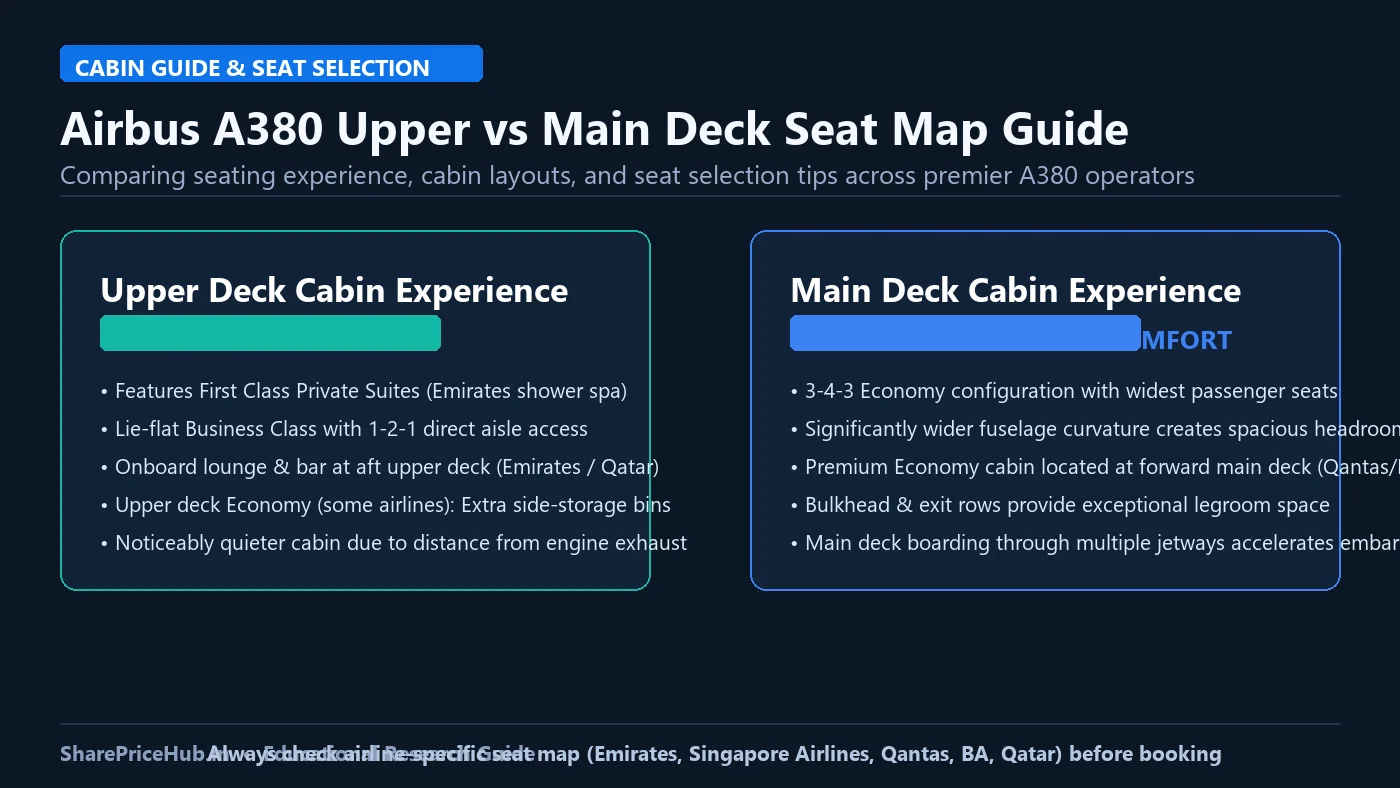
When reading a seat map, look for the position of windows, wing area, lavatories, galleys, exit rows, bassinet positions and the distance to high-traffic areas. A seat near the galley or lavatory may be convenient for some travellers and noisy for others. Seats with extra legroom can have restrictions, such as fixed armrests or limited under-seat storage. Bulkhead seats may offer more space in front but may also place screens or tables in the armrest.
On the upper deck, some airlines place business class or premium economy, but cabin placement varies. A seat map should not be interpreted by a rule such as “upper deck is always better.” Compare the seat pitch, recline, aisle access, privacy, noise, cabin service and price for the actual configuration. A solo traveller may value a different seat from a parent travelling with a child.
Use the airline’s official seat-selection map when possible. Third-party diagrams can be helpful for planning, but they may be outdated or show a generic layout. Do not rely on a seat map for special accessibility arrangements without confirming directly with the airline.
Airbus A380 inside: what the interior looks like
The A380 cabin feels different because of the two passenger decks and the amount of interior space. The exact interior depends on the operator and the cabin refit history. Standard areas include economy seating and galleys, while some aircraft also feature premium economy, business class, first class and shared premium-cabin areas. Some airlines have installed lounges, bars, suites or showers in selected cabins. These features are airline-specific and may not be present on every aircraft that carries the A380 name.
Passengers often search for “airbus a380 inside” or “airbus a380 interior” to see cabin photos before booking. Make sure images match the airline and cabin class. A luxurious first-class suite photo does not represent the economy cabin, and a photo from one airline cannot be assumed to show another carrier’s interior. If you publish cabin images, label the airline, cabin and aircraft configuration when verified, and use images the website has permission to display.
The aircraft’s large cabin can support a quiet-feeling, spacious premium experience, but passenger comfort still depends on seat design, cabin density, lighting, noise, crew service and the length of the flight. Even on the same aircraft, a seat in economy and a suite in first class are very different products. Read the airline’s cabin page rather than judging the whole aircraft from one promotional image.
Airbus A380 first class: what to know before booking
A380 first class can be a premium product on airlines that choose to offer it. Depending on the carrier and configuration, it may include a private suite, lie-flat bed, upgraded dining and access to selected premium lounges or onboard facilities. Some operators have installed very high-end features such as shower rooms or enclosed suites, but those amenities are not universal. They may also be available only on particular aircraft or routes.
The word “first class” does not automatically mean the same seat, service or price across airlines. Compare the actual seat map, bedding, privacy, dining, lounge access, baggage rules, change conditions and ticket fare. Check whether a route is operated by an A380 with the expected cabin. A flight number can be scheduled with one aircraft type and later changed for operational reasons, so review the booking close to departure.
For value, calculate what matters to you. A traveller who needs to sleep on an overnight flight may value a bed and privacy; another may prefer to save money and spend on the destination. If the fare is paid by a company or redeemed with points, the value calculation is different from a cash ticket. Avoid describing first class as objectively “worth it” for every traveller: it depends on budget, purpose and personal preferences.
Airbus A380 Emirates: routes and seat information
Emirates is the best-known A380 operator and has used the aircraft on many long-haul routes. Its official announcement on 9 July 2026 said it would introduce A380 service to Delhi from 25 October 2026, with Delhi joining Mumbai and Bengaluru as Indian cities served by the A380 at that time. It also stated that Kolkata–Dubai would be served by the A350 from 25 October, while other flights on the route would use a retrofitted Boeing 777. Schedules can change, so do not assume every Emirates flight to or from India uses an A380.
Use Emirates’ official announcement about A380 services to Delhi and the airline’s booking page for current flight details. Search results can show a route served by different aircraft on different daily departures. Check the actual flight number and planned aircraft before choosing a seat or buying a ticket for a specific cabin.
An Emirates A380 seat map should be checked by cabin class. Emirates’ premium economy, business and first-class arrangements can vary by aircraft and retrofit stage. If the seat map offers a choice between upper and lower decks, compare the cabin and seat itself rather than assuming one deck is always preferable. Photos and cabin descriptions should be tied to the correct aircraft configuration.
Airbus A380 Lufthansa: cabin and availability
Lufthansa has operated A380 aircraft on selected long-haul routes, including some flights from its Munich hub. But availability varies by season, fleet planning, route demand and maintenance. A historical Lufthansa A380 route is not proof that the airline will use the aircraft on the same route on a future date. Always verify the flight’s current aircraft type in the official booking flow and check the cabin layout associated with the aircraft.
For a Lufthansa A380 seat map, check the airline’s seat-selection page for the actual flight. Do not copy an Emirates or Etihad diagram into a Lufthansa guide. Even if two planes are both A380-800s, seat count, business-class configuration, premium cabins, lavatory positions and economy layout can be different. An aircraft may also have undergone a refit, which changes the available seats and passenger experience.
Travellers should compare the ticket conditions, connection time, baggage allowance, lounge eligibility and seat-selection charges as well as the aircraft. A flight operated by another aircraft type can still be the better choice if its timing, fare or connection fits the traveller’s plans. Use current airline data for live availability rather than keeping an old route list in a “today” article.
Airbus A380 Etihad: premium cabins and route checks
Etihad has brought its A380 back to selected routes and has promoted a premium onboard experience across Economy, Business, First and its Residence concept on applicable aircraft. On 26 October 2026, Etihad announced daily A380 services between Bangkok and Abu Dhabi, with the inaugural service on 26 October 2026. See Etihad’s official announcement for the route and cabin details. This shows why route information needs a date: the network can expand or change, and a route announced this week should not be treated as permanent forever.
When researching “airbus a380 etihad,” use the airline’s current schedule, cabin details and booking page. Confirm the operating date and flight number. The A380 may have a different cabin layout from the airline’s other aircraft, and premium amenities apply only to the relevant cabin and aircraft. If an article describes the Residence or a first-class apartment, make clear that it is not an economy cabin feature and is not available on every flight.
The same rule applies to seat maps and photographs. Do not use a generic double-decker airplane image to imply that every Etihad A380 cabin includes the same suites, lounges or onboard facilities. Use verified cabin information and indicate that equipment can be substituted before departure.
Airbus A380 ticket price in India: why fares vary
There is no fixed “Airbus A380 ticket price in India.” Airlines sell tickets by route, date, cabin, booking time, demand, fare rules and connecting itinerary—not by aircraft type alone. An A380 flight can be cheaper than another flight on some dates and more expensive on others. Economy fares can vary widely, while premium economy, business and first-class tickets use very different fare levels and restrictions.
For an Indian traveller, compare the full itinerary from the city of departure to the destination. Check whether the A380 segment is direct or connected through a hub such as Dubai or Abu Dhabi. Compare total journey time, baggage rules, transit requirements, refund and change fees, seat-selection costs and arrival time. The lowest displayed fare may not include the services you need, and a connection may change the total travel time substantially.
To estimate a budget, search the airline’s official booking system for the exact dates and cabin, then compare reputable booking providers using the same conditions. Prices can change when seats sell, inventory changes or the route schedule changes. If you publish an example fare, include the route, travel dates, cabin, source and date checked. Do not publish a ticket price from an old screenshot as though it were a current national price.
Airbus A380 flights: how to confirm which aircraft operates
A route can be served by more than one aircraft type. An airline may operate some daily flights with an A380 and other services with a Boeing 777, A350 or another aircraft. Equipment changes can also occur because of maintenance, operational needs, seasonal demand or a fleet plan. The route name alone is not enough to confirm that a particular trip uses the A380.
Before booking, search the exact travel date and flight number. Check the aircraft-type display, then confirm the seat map for that flight. Recheck the itinerary before departure because planned equipment can change. If sitting on an A380 is the main reason for your trip, understand the airline’s conditions: an aircraft change may be outside your control, and a ticket does not always guarantee a specific aircraft type.
The A380 is primarily used on long-haul routes between major airports, according to Airbus. It can serve routes where the airline expects enough passengers to justify a large aircraft. Airlines assess capacity, runway and gate infrastructure, connecting traffic, costs and demand. A large plane is a tool for a particular route network, not simply a sign that the airline offers a better flight.
Airbus A380 vs Boeing 777: which is better?
The Airbus A380 and Boeing 777 serve overlapping long-haul markets but use different aircraft designs. The A380 has two full passenger decks and four engines; the Boeing 777 family is a twin-engine wide-body family with multiple variants and cabin layouts. An A380 may carry more passengers in a typical configuration, while a Boeing 777 may offer an airline more flexibility on routes where demand does not justify a very large aircraft. There is no universal winner because the model and airline layout matter.
| Factor | Airbus A380 | Boeing 777 family |
|---|---|---|
| Deck layout | Two full passenger decks | One main passenger deck |
| Engines | Four | Two |
| Passenger capacity | Up to 853 certified; airline layout usually lower | Varies widely by variant and airline layout |
| Typical role | High-demand long-haul routes | Wide range of medium- and long-haul routes |
| Seat map | Depends on airline configuration | Depends on variant and airline configuration |
| Best passenger choice | Depends on seat, service, schedule and fare | Depends on seat, service, schedule and fare |
For passengers, compare the actual flight rather than the aircraft name alone. A modern, refitted 777 may provide a cabin that a traveller prefers over an older A380, while another traveller may specifically enjoy the A380’s upper-deck experience. Airline service, seat pitch, privacy, entertainment, noise, food, fare and schedule often matter more than the manufacturer’s name.
For airlines, operating economics includes fuel use per flight, maintenance, crew, airport requirements, passenger yield, cargo opportunities and the ability to fill the seats. A very large aircraft can be efficient when demand is strong, but can be less flexible when demand is uneven. The end of new A380 production also means airlines must consider long-term fleet support and the future cost of maintaining their existing aircraft.
Common mistakes when comparing aircraft prices and seats
One common error is treating a historic list price as the current purchase price. The US$445.6 million figure belongs to Airbus’s 2018 average list price. It is not a live offer. Another mistake is converting the price into rupees without naming the exchange rate and date; an international price changes in local currency as exchange rates move.
A second error is treating the A380’s maximum certified capacity of 853 as the passenger count on every airline. Actual seating depends on the airline’s configuration. A third mistake is assuming a seat map from one carrier fits another. Use the actual airline and aircraft version. Finally, do not assume a certain destination is served by an A380 year-round. Schedules and equipment can change, so check the exact flight date.
Frequently asked questions
What is the Airbus A380 price today?
There is no new-production Airbus A380 price today because the programme has ended. Airbus’s historic 2018 average list price was US$445.6 million. A used aircraft’s value depends on its condition, age, maintenance, engines and deal terms.
What is the Airbus A380 price in Indian rupees?
Using an illustrative exchange rate of ₹90 per US dollar, the historical US$445.6 million list price converts to about ₹4,010.4 crore. This is an example conversion, not a current sale price or a live foreign-exchange quote.
What is the Airbus A380 seating capacity?
Airbus says the A380 is certified to carry a maximum of 853 passengers. Airlines usually fit fewer seats because cabin layouts and premium classes vary.
What is the Airbus A380 size?
It is roughly 72.7 metres long, with a wingspan around 79.8 metres and a height around 24.1 metres. Verify dimensions for the precise variant and source before publishing a technical specification table.
What is an Airbus A380-800?
The A380-800 is the main passenger version known for its double passenger decks and four engines.
Does Emirates fly the A380 to India?
Emirates announced A380 service to Delhi from 25 October 2026, joining Mumbai and Bengaluru in its Indian A380 destinations at the time of the announcement. Check the exact flight and date because schedules can change.
Does Lufthansa operate the A380?
Lufthansa has operated A380s on selected routes, but current availability depends on schedule and fleet plans. Confirm the aircraft on the official booking page for your date.
Does Etihad operate the Airbus A380?
Etihad has relaunched A380 services on selected routes, including the announced Bangkok–Abu Dhabi daily service in October 2026. Verify current route schedules before travelling.
How do I find the Airbus A380 seat map?
Use the operating airline’s seat map for the exact flight number and date. Layouts differ by airline and aircraft configuration.
What is the Airbus A380 ticket price in India?
There is no fixed ticket price by aircraft. Fare depends on route, date, cabin, demand, booking time and fare conditions.
Is Airbus A380 better than Boeing 777?
It depends on the airline’s cabin, flight schedule, fare and passenger needs. The A380 has two passenger decks and four engines; the 777 is a twin-engine wide-body family with many variants.
Conclusion
The A380 remains one of the most recognisable passenger aircraft because of its double-deck cabin and large capacity. Airbus lists a maximum certified seating capacity of 853, a range of about 8,000 nautical miles and 251 deliveries to 14 customers. Production has ended, although Airbus says it will continue supporting airlines that operate the aircraft. Its historical 2018 average list price was US$445.6 million, but that is not a current new-aircraft price. For travellers, the most useful facts are the actual airline seat map, current route, flight number, ticket conditions and cabin layout. Verify current flights with Emirates, Lufthansa or Etihad as appropriate, and do not assume that every flight to a destination uses the A380. A reliable guide separates manufacturer specifications, historical price references and live ticket information.
Disclaimer
This article is for general educational and travel-planning information. Aircraft specifications and airline schedules can change, fares vary by booking conditions, and historical prices are not current quotations. Confirm the exact aircraft, seat map, fare and flight schedule with the operating airline before booking.