
Updated 31 October 2026. Australia’s latest ACCC weekly fuel report, published on 30 October, found average retail petrol prices had fallen across capital cities and regional areas in the previous week. The five largest capital cities averaged 233.8 cents per litre on 28 October. This guide explains the latest dated figures and why prices still differ by station and location.
Key Takeaways
- The ACCC’s 30 October 2026 report found average retail petrol prices fell over the previous week in capital cities and regional areas.
- The five largest capital cities averaged 233.8 cents per litre on 28 October, down 2.4 cents from the previous week.
- Diesel prices moved differently and increased slightly in most locations in the latest weekly update.
- Fuel costs depend on global refined-fuel prices, the Australian dollar, transport, taxes and local competition.
- There is no single live price for all of Australia; compare the same fuel grade, location and time.
Latest data sources: Read the ACCC weekly fuel monitoring updates, the ACCC report published 30 October 2026, and the Australian Institute of Petroleum weekly petrol report. For related market context, read our Brent crude oil price guide and RBA cash rate outlook.
Quick answer: why are Australia fuel prices high?
Australia’s petrol and diesel prices are shaped by international refined-fuel prices and crude-oil conditions, the Australian dollar’s value, shipping and distribution costs, domestic competition, fuel taxes and local pricing cycles. The government does not set a single nationwide retail petrol price; the ACCC says petrol, diesel and automotive LPG prices are deregulated and determined by the market. A global oil-price shock can push up wholesale costs, but the amount and timing of the retail change can differ between locations.
| Factor | How it can affect the price at the pump |
|---|---|
| International oil and refined-fuel prices | Higher benchmark prices can raise the cost of importing or replacing fuel. |
| Australian dollar | A weaker dollar can make internationally traded fuel more expensive in Australian dollars. |
| Refining and supply | Refinery availability, product quality and import conditions influence wholesale costs. |
| Freight and distribution | Moving fuel to terminals and stations costs money, especially in distant regions. |
| Taxes and charges | Excise and GST affect the retail price paid by drivers. |
| Local price cycles and competition | Prices can rise or fall at different times in different cities and suburbs. |
The key point is that “fuel is expensive” is not one simple diagnosis. A useful answer compares the local price with recent local prices, wholesale costs and the same fuel type, rather than comparing one station with a different city or a different month.
How much is fuel in Australia today?
For a dated comparison, the ACCC’s 30 October report showed the following daily average retail petrol prices on 28 October 2026. Figures are cents per litre (cpl), not a live price at a named service station.
| Capital city | Average petrol price on 28 October 2026 (cpl) | Change from previous week (cpl) |
|---|---|---|
| Sydney | 235.5 | −3.3 |
| Melbourne | 235.5 | −0.7 |
| Brisbane | 236.4 | −1.0 |
| Adelaide | 227.7 | −5.6 |
| Perth | 233.7 | −1.5 |
| Canberra | 245.5 | −0.8 |
| Hobart | 244.3 | −1.5 |
| Darwin | 243.4 | −1.7 |
The average across the five largest cities was 233.8 cpl on 28 October, down 2.4 cpl from the previous week. Among the eight capitals in the table, Adelaide had the lowest and Canberra the highest average on that date. These city averages cannot tell you the price at a particular pump.
There is no single answer to “how much is fuel in Australia” that works for every driver. Prices are usually displayed in Australian cents per litre, and the exact amount depends on the state, city, suburb, station, fuel grade and time. A 91-octane unleaded price should not be compared directly with premium unleaded or diesel. A regional station may also have different transport costs and competitive conditions from a station in a large city.
The ACCC monitors fuel prices in the five largest capital cities and more than 190 regional locations. Its weekly reports explain recent changes and compare retail, wholesale and international benchmarks. For a practical check, use the latest official ACCC update for the trend and a reputable local fuel-price service or state app for the exact station price near you. Always note the date and time because a pump sign can change after you have checked it.
To estimate a refuelling bill, multiply the displayed price per litre by the number of litres you buy. For example, if a station price were 200 cents per litre, that would equal A$2.00 per litre. A 50-litre purchase at that hypothetical price would cost A$100. This is a maths example, not a claim that 200 cents is the current national average. Use the live local price for an actual budget.
Is fuel expensive in Australia compared with the past?
To decide whether petrol is expensive, compare the current local price with a meaningful period, such as the past month, quarter or year. A single high day may reflect a local price cycle rather than a lasting nationwide change. A full-year average may hide sharp temporary increases. Drivers can use both views: the short-term view helps decide when to fill up, while the longer-term view helps plan a household budget or business fleet costs.
It is also useful to separate the nominal price from the cost as a share of income. A price of A$2.00 per litre can feel different to a household with a long commute and a low income than it does to a household that drives very little. Compare fuel spending with weekly pay, travel distance and vehicle efficiency. Some countries have lower pump prices but different income levels, taxes, subsidies or public transport choices; a simple ranking does not show the full cost of mobility.
When people ask “is petrol expensive in Australia?”, the most accurate answer is: it can be expensive for a particular household or region, and the price can rise sharply during a global or local supply shock, but the comparison needs a date, a location and a fuel grade. A clear article should not claim that Australia is always one of the world’s most expensive fuel markets without a verified, like-for-like dataset.
Why is fuel so expensive in Australia? The main causes
International crude oil and refined fuel
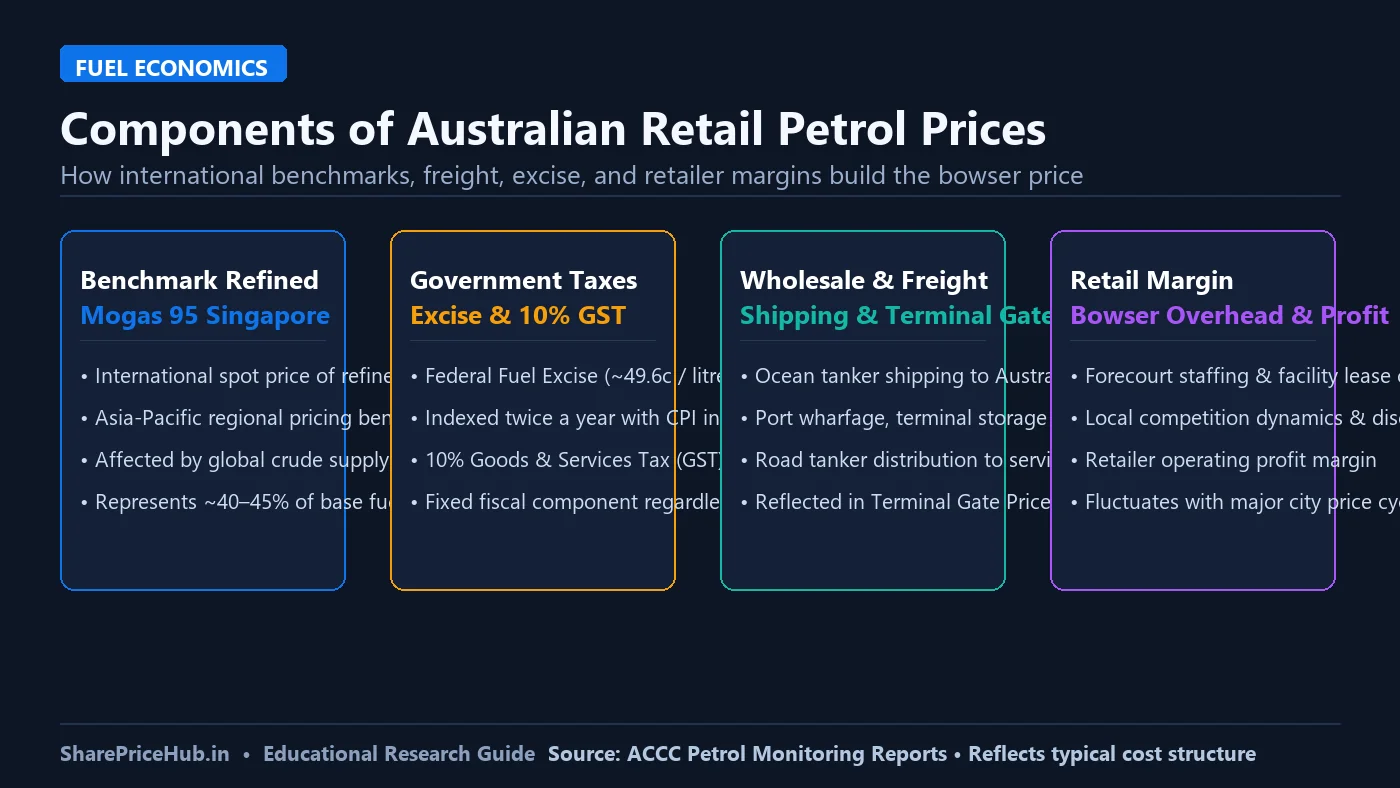
Crude oil is a major input into petrol and diesel, but retail prices are not a direct one-for-one copy of a crude-oil quote. Fuel must be refined into the correct product, shipped, stored and distributed. Australia’s retail price can be influenced by international refined-fuel benchmarks, not only the headline crude price. During a supply disruption or conflict that affects oil production, shipping routes or refining, benchmark costs may rise before the full effect appears at the pump.
The ACCC’s 30 October 2026 weekly update discussed price movements after the conflict in the Middle East began in late February 2026. It found average retail petrol prices had fallen in capital cities and regional locations over the previous week, while diesel prices had risen slightly in most locations. That does not mean every part of the supply chain had returned to normal. Retail prices can lag wholesale movements, and different fuel types can respond at different speeds.
The Australian dollar and import cost
Fuel is traded internationally, commonly using US-dollar benchmarks. If the Australian dollar weakens against the US dollar, the Australian-dollar cost of the same international fuel price can rise. If the Australian dollar strengthens, it can cushion some of the increase. The currency is only one factor, and the effect depends on the timing of contracts, hedging, shipping and wholesale pricing. Do not claim that every petrol increase is caused by the currency; check the period and compare the other inputs too.
Taxes and fuel charges in Australia
Fuel prices include federal fuel excise and the Goods and Services Tax (GST), subject to the applicable tax rules and current rates. These costs form part of the amount paid by a driver, but they do not explain every day-to-day movement. When crude or refined-fuel prices change, the retail price can move even if the tax framework has not changed. Any article that lists exact tax rates should verify them against current Australian Government information before publication because rates, indexation and temporary policy measures can change over time.
“Fuel charges in Australia” can also refer to costs a business adds for delivery, freight or vehicle use rather than official government taxes. Make that distinction clear. A freight surcharge charged by a company is not automatically a government fuel tax. For household budgeting, the pump price is the immediate amount, while taxes, wholesale costs and distribution costs explain how that price is formed.
Refining, imports and domestic logistics
Fuel has to move from refineries or import terminals through storage facilities, road tankers and local stations. Freight, labour, energy, storage, insurance and compliance all cost money. A city with many nearby stations may have more direct competition than an isolated town where supply options are limited. Longer transport routes can contribute to regional differences, although the final price still depends on local margins and other market factors.
Australia relies on a combination of domestic refining and imported refined fuel. The exact balance changes over time, and supply risks can rise when an overseas refinery has an outage or shipping is disrupted. The right way to discuss a shortage is to use the latest official supply information; do not assume that a high price means the country is about to run out of fuel.
Local price cycles and competition
Some Australian cities experience retail petrol price cycles. A price can rise over several days and then fall as stations compete for customers. The cycle’s timing and size vary by city and over time. A driver who fills up at the top of a cycle can pay more than a neighbour who fills up a few days later, even though both are in the same market. The ACCC publishes buying tips for the five largest cities and explains why prices can differ between locations.
Competition matters too. Stations may respond to nearby competitors, store strategy, convenience-store sales and local traffic patterns. Two outlets on the same road can show different prices. The cheapest station is not always the best total choice if it requires a long detour that uses more fuel than the saving is worth.
Australia fuel price shock cost: how to calculate its effect
A fuel price shock is a sudden or large change that makes the cost of driving or transporting goods rise over a short period. To understand the effect, calculate the litres you use and multiply that amount by the change in price. This is more helpful than saying a price increase “feels large” without connecting it to a real budget.
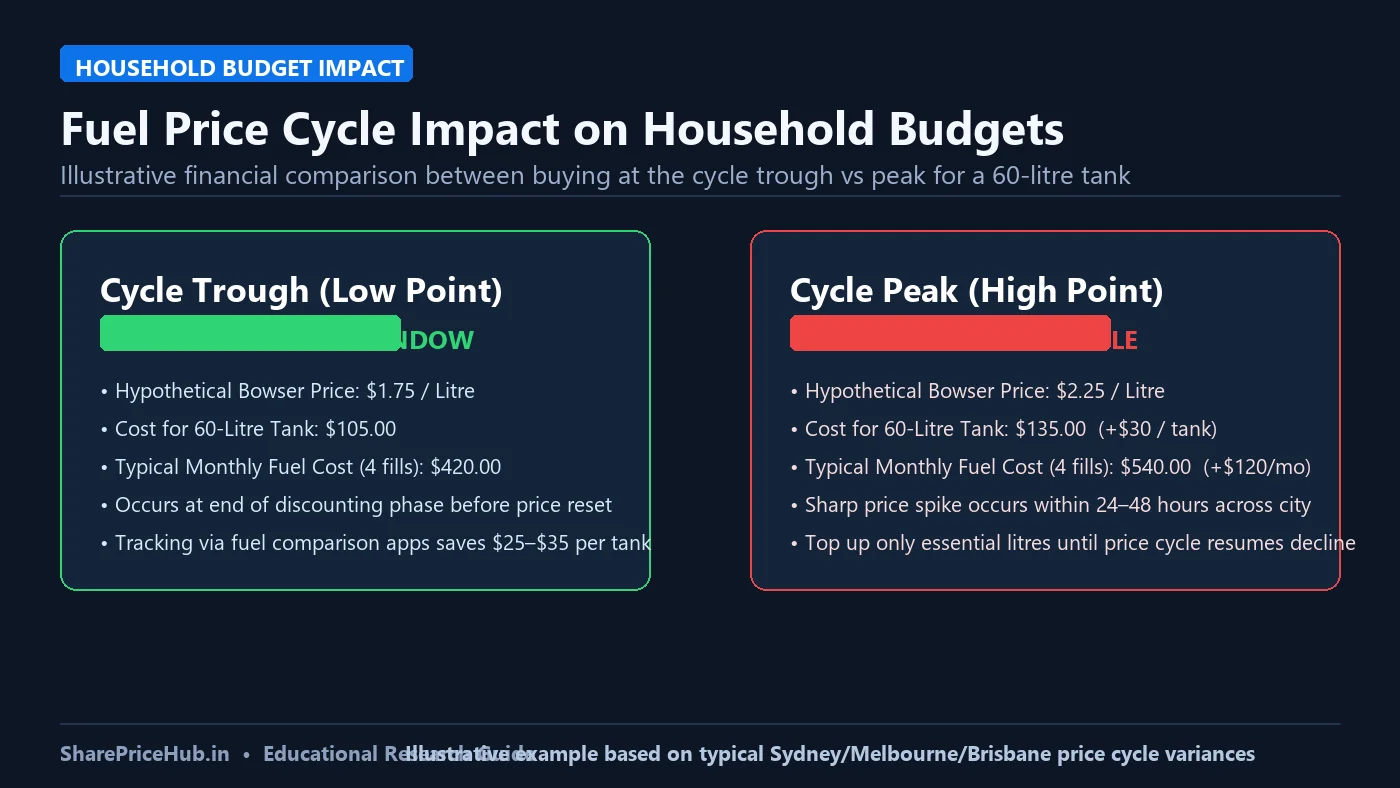
Illustrative example only: suppose your usual fill is 50 litres. If the price rises from A$1.70 to A$2.00 per litre, the increase is A$0.30 per litre. The extra cost for that fill is 50 × A$0.30 = A$15. If you buy that amount four times in a month, the additional cost would be A$60, assuming the same prices and quantities each time. These are hypothetical inputs, not current Australian price observations.
For a business, calculate fuel change across the entire fleet. A delivery van that uses 90 litres per week would spend an additional A$27 per week when fuel rises by A$0.30 per litre. Across ten similar vehicles, the additional weekly cost would be A$270 before any changes in routes or driving behaviour. A company may respond with route planning, a fuel surcharge, greater efficiency or a price negotiation, but it should explain the basis for any surcharge clearly to customers.
Why different cities and regions pay different prices
The phrase “Australia petrol pump price” can mean a local station quote, a city average or a national average. Those figures are not interchangeable. A capital-city average combines multiple stations and can hide the gap between cheaper and more expensive suburbs. Regional locations can have fewer competitors and longer distribution routes, but regional prices do not always move in the same direction as city prices.
To compare prices fairly, use the same fuel grade and the same time window. Compare unleaded 91 with unleaded 91, not with premium 98. Compare retail with retail, not a wholesale benchmark with a retail pump price. A monthly average is not the same as a single station price. If you make a chart, label the data source, location, unit and date range, and do not join data from different definitions as though it were one continuous series.
The ACCC says it tracks retail fuel prices in major capital cities and more than 190 regional locations. That makes its reports useful for understanding broad price movements. The latest 30 October report also compares daily prices and wholesale indicators. However, the ACCC does not set fuel prices or promise a future price. Its work is monitoring and reporting rather than a promise of a particular price for the coming week.
Will fuel prices go down in Australia?
They can, but no one can reliably promise the exact date or amount of a fall. Prices may decline when international refined-fuel benchmarks soften, supply improves, freight conditions normalise, the Australian dollar strengthens or local competition pulls retail margins down. The 30 October ACCC report is a later example: average retail petrol prices decreased over the previous week, while diesel prices moved slightly higher in most locations. A later week may show a different trend.
Prices may remain high or rise again if crude oil rises, a refinery or shipping disruption reduces supply, the Australian dollar weakens, demand increases or the local price cycle turns upward. Changes at each stage do not always reach the pump immediately. Wholesale prices can move before a station changes its sign, and stations may adjust on different days.
A good fuel-price forecast should therefore be framed in scenarios rather than promises. The near-term direction depends on benchmark prices, currency rates, supply news and local retail patterns. If the article is published with “today” in its title, update the date, data and conclusion regularly. If no current source proves a fall is likely, say that the direction remains uncertain.
What will happen if Australia runs out of fuel?
A nationwide fuel shortage would be a serious supply emergency, but a high petrol price on its own does not prove that Australia is running out of fuel. A shortage could result from a combination of interrupted imports, refinery outages, transport disruption, panic buying or a prolonged international supply shock. The actual outcome would depend on the size of the disruption, available inventories, government response, ports, distribution networks and how demand changes.
If supply were genuinely restricted, authorities and suppliers might prioritise essential services such as emergency response, food supply, health care and critical transport. Businesses could change delivery schedules, public transport use could rise where it is available, and some services might face delays. Governments could provide public updates, work with industry on supply logistics or introduce emergency measures if the law and situation required them. Do not write that rationing or a particular policy will definitely occur unless an official announcement confirms it.
For households, sensible preparation is different from panic buying. Keep a reasonable amount of fuel for normal needs, maintain the vehicle, plan essential journeys, and follow updates from official authorities. Filling every available container with fuel can create fire and safety risks and may worsen a local shortage. Use approved containers and follow local safety rules; do not store fuel in a way that endangers people or property.
Is Australia overpriced? Understanding the cost-of-living question
The search “why is Australia so overpriced?” is broader than petrol. It may refer to housing, groceries, insurance, transport or the general cost of living. Fuel is only one expense in that picture. A high cost in one country cannot be judged only by converting the price into another currency; wages, taxes, distances, household travel patterns, public transport, vehicle efficiency and other costs also matter.
For a fair comparison, separate the price of one litre from the total monthly cost of travel. A household that drives 500 kilometres per week may feel a fuel increase more than a household that drives 80 kilometres. A fuel-efficient hybrid may cost more to buy but less to run; an electric vehicle shifts energy spending toward electricity and charging access rather than petrol. These choices depend on purchase price, how long the owner keeps the vehicle, driving habits and access to suitable charging or public transport.
It is also wrong to assume that all of Australia pays the same amount. A driver in a city with many stations and public transport alternatives has different options from a driver in a remote area. An article should explain the local setting rather than concluding that every Australian household is facing the same burden.
Which country has the cheapest fuel in the world?
There is no timeless answer. Countries’ pump prices change with global oil prices, exchange rates, taxes, subsidies, local production and official pricing policies. A country with substantial oil production or fuel subsidies may have a much lower retail price than Australia, while a high-tax country may show a higher pump price. A list published in one month can quickly become outdated, and some comparisons use different grades or dates.
Another issue is affordability. The cheapest nominal price does not necessarily mean driving is easiest to afford. Incomes, the cost of cars, the availability of buses and trains, fuel efficiency and the need to travel long distances affect the total burden. A meaningful comparison may show both pump price and the share of typical income needed to buy a set amount of fuel. If reliable comparable data is not available, avoid claiming one country is definitively the cheapest in the world.
When writing this section for search intent, answer the question directly but explain the limits: countries with fuel subsidies or large domestic supply often appear among the lowest-price markets at a particular point in time, but the ranking depends on the source, date and method. Readers should check a current international comparison rather than rely on a fixed list.
Practical ways to reduce fuel cost
Compare local prices. Check a trusted state fuel-price app or price service before leaving. Compare the same grade and consider whether the detour will use more fuel than it saves.
Plan routes. Combine errands, avoid unnecessary backtracking, and use live traffic information when appropriate. Stop-start traffic and long detours can increase consumption.
Drive smoothly. Rapid acceleration, hard braking and unnecessarily high speeds can raise fuel use. Keep a steady, safe pace and use the gear recommended for the vehicle.
Maintain tyre pressure. Follow the manufacturer’s recommended pressure for the load and conditions. Underinflated tyres can increase rolling resistance and wear unevenly.
Remove unnecessary weight. Heavy items and roof accessories can increase consumption. Keep only the equipment you need for the journey.
Choose the right fuel. Use the grade recommended in the vehicle manual. Paying for premium fuel may not improve performance in a vehicle that does not require it.
Review the vehicle choice. For a high-mileage driver, fuel efficiency may matter greatly. Compare the total cost of ownership, including purchase price, maintenance, insurance, fuel or electricity and resale value.
Budget with real usage. Track litres purchased and kilometres driven. The cost per 100 kilometres can help compare vehicles and see whether a change in driving habits made a difference.
Common mistakes when reading fuel-price news
The first mistake is treating one station’s price as the national average. Always note location, grade and timestamp. The second is treating crude oil and retail petrol as identical prices. Refined products, freight, taxes and margins sit between them. The third is assuming that a decline in wholesale prices will appear at every pump immediately. Retail pricing can lag and local price cycles can change the timing.
Another mistake is confusing a price-monitoring report with a forecast. The ACCC reports market movements and has stated that it does not predict petrol prices. A news story may quote an analyst’s forecast, but that is not the same as an official guarantee. Finally, avoid dramatic claims about a nationwide fuel shortage unless current official sources support them. A sharp rise in price may reflect scarcity concerns, but it can also be driven by benchmark prices, currency movements and local retail changes.
Frequently asked questions
How expensive is petrol in Australia now?
There is no single national price for every station. Check the latest local price for your fuel grade and compare it with the dated ACCC trend report. The ACCC update published on 30 October 2026 reported that average petrol prices had fallen over the previous week. Its daily table showed a five-largest-city average of 233.8 cpl on 28 October. Local station prices vary.
Why is fuel getting so expensive in Australia?
Potential causes include higher international refined-fuel costs, a weaker Australian dollar, shipping or refinery disruption, taxes, distribution costs and local pricing cycles. The mix changes over time.
Will fuel prices go down in Australia?
They may fall if wholesale benchmarks ease, supply improves or local competition increases. Prices can also rise again; the ACCC does not provide a guaranteed fuel-price forecast.
Is petrol expensive in Australia compared with other countries?
It depends on the date, fuel grade, currency, tax policy, income levels and travel needs. A fair comparison uses comparable, current data.
What is Australia’s fuel rate?
The “Australia fuel rate” usually means a price per litre for a named fuel type and location. Always specify the grade, location and timestamp.
What are fuel charges in Australia?
The phrase may refer to government taxes such as fuel excise and GST, or to business charges such as freight and delivery surcharges. Explain which meaning is intended.
What happens if Australia runs out of fuel?
A severe shortage could disrupt transport and deliveries and trigger official supply measures. A high price alone does not prove a national shortage. Follow official information and do not panic-buy.
Which country has the cheapest fuel in the world?
There is no permanent ranking. Prices change with subsidies, taxes, production, exchange rates and the date of comparison.
How can I find a cheaper petrol pump price?
Use a reputable state fuel-price app or local comparison service, compare the same grade and account for the distance needed to reach the station.
Why can fuel prices differ within the same city?
Stations have different competition, costs, traffic patterns and price-cycle timing. A city average hides local differences.
Conclusion
Australia fuel prices change because global supply, refined-fuel benchmarks, currency movements, transport costs, taxes, local competition and retail price cycles interact. The ACCC’s 30 October 2026 update reported that average retail petrol prices had decreased over the previous week, while diesel had edged higher in most locations. Its five-largest-city petrol average was 233.8 cpl on 28 October, but that does not establish today’s price at every pump. Use a dated source for current figures, compare the same fuel grade, and use actual litres and kilometres to estimate the impact on your budget. Prices may fall or rise; no reliable article should promise a date without supporting evidence. Plan purchases sensibly, avoid panic buying and check official updates when there is a genuine supply concern.
More Australia fuel-price questions
What does “Australia price petrol” mean?
The search phrase “Australia price petrol” generally asks for the price motorists pay at the pump. There is no single price for every driver: location, fuel grade, retailer, timing and local competition can all change the amount shown at a service station.
What affects fuel cost in Australia?
Fuel cost in Australia is influenced by international refined-fuel prices, the Australian dollar, taxes, transport and storage costs, wholesale margins, local competition and the timing of a retailer’s price cycle. Compare the same fuel grade and the same date when checking prices between cities or states.
Disclaimer
This article is general information, not personalised financial or motoring advice. Fuel prices and government policies can change. Verify current prices, taxes and safety guidance through official Australian sources before making decisions.